
Updated October 2026
How did the Jewish people return from Babylonian exile, rebuild Jerusalem, and restore their temple worship? The books of Ezra and Nehemiah tell that story. The events span more than a century, involve several Persian kings, and are not always recorded in chronological order (e.g. Ezra 4 is not arranged in strict chronological order).
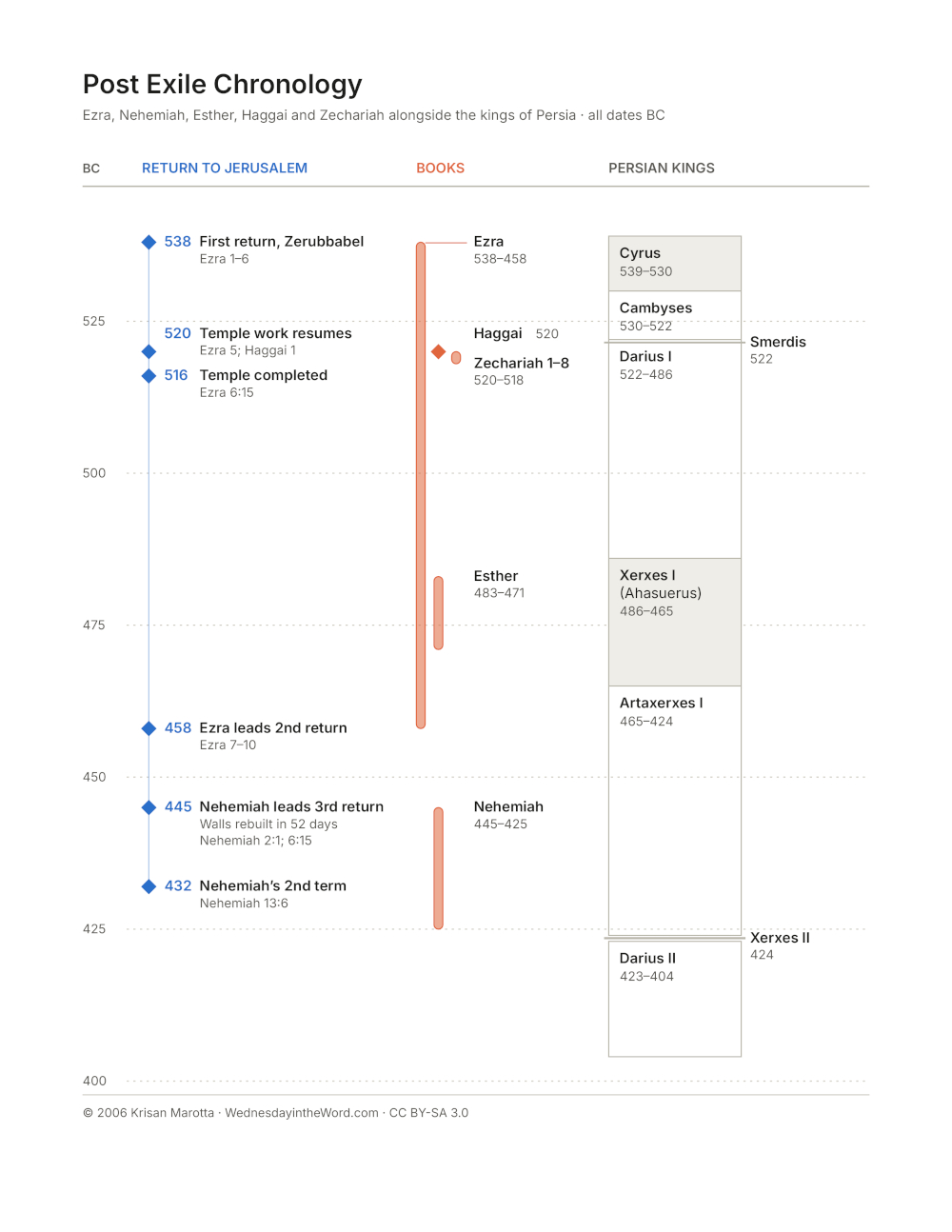
This timeline places the major events of Ezra and Nehemiah in historical order, alongside the ministries of Haggai and Zechariah and the events of book of Esther.
The story unfolds in three major stages: rebuilding the temple, restoring obedience to God's Law, and rebuilding Jerusalem's walls.
Download a free PDF of the post-exile Chronology as a chart
Chronology of the post exile: Ezra-Nehemiah
*Years are approximate based on traditional dating.
1. The First Return: Rebuilding the Temple (539–516 BC)
After Babylon conquered Jerusalem in 586 BC, many people of Judah lived in exile. In 539 BC, Persia conquered Babylon. Cyrus, king of Persia, allowed the Jewish exiles to return to Jerusalem and rebuild their temple.
- 539 BC: Fall of Babylon; Daniel 5:30
- 539–538 BC: First year of Cyrus 539-530 BC ruling over Babylon; Ezra 1:1-4
- 538-537 BC: Zerubbabel and 1st return of the exiles; Ezra 1-6
- 537 BC: Building of Altar; Ezra 3:1-3; 7th month = Tishri, Sep/Oct
- 536 BC: Work on temple begins; Ezra 3:8
- 536–530 BC: Opposition during Cyrus’s reign; Ezra 4:1-5
- 530–520 BC Work on temple was interrupted by opposition and remained unfinished until about 520 BC: Ezra 4:24; Persian King: Cambyses 530-522
- 520 BC: Work begins again under Darius I 522-486; Ezra 5:2
- 520 BC: Events of book of Haggai; Haggai 1
- 520–518 BC: Events of book of Zechariah 1-8
2. The Years Between: Esther and the Persian Empire (516–458 BC)
During this period, many Jews continued to live throughout the Persian Empire rather than returning to Jerusalem. The book of Esther reminds us that the story of the Jewish people was unfolding in more than one place. While some had returned to Judah, others continued living in Persia.
- 516 BC: Temple completed; Ezra 6:15. Note: Some timelines use 515 BC because of differences in reckoning Persian regnal years and ancient calendars.
- 483–471 BC: Events of Book of Esther under Xerxes I (Ahasuerus) 486-465
3. The Second Return: Ezra Restores God's Law (458 BC)
458 BC: Ezra and 2nd return of exiles; Ezra 7-10
- Ezra receives authorization from Artaxerxes I and travels to Jerusalem; Ezra 7-8
- Ezra confronts the community's unfaithfulness and calls for repentance; Ezra 9-10
- The community investigates and address the unlawful marriages; Ezra 10:16-17
4. The Third Return: Nehemiah Rebuilds Jerusalem's Walls (445 BC)
About thirteen years after Ezra's arrival, Nehemiah learned that Jerusalem's walls remained broken down.
Nehemiah served as cupbearer to King Artaxerxes I. When he heard about Jerusalem's condition, he sought the king's permission to return and rebuild its walls.
445–444 BC: 20th year Artaxerxes I (Artahasta) 465-425; Nehemiah 1:1; Chislev= Nov/Dec
- Nehemiah approaches the King: Nehemiah 2:1; Nisan=Mar/Apr
- Nehemiah and 3rd return of exiles; Nehemiah 2:11
- Wall of Jerusalem completed; Nehemiah 6:15; Elul = Aug/Sep
444–432 BC: Nehemiah governor of Judah; Nehemiah 5:14
432 BC: Nehemiah goes to Babylon; Nehemiah 13:6
after 432 BC: exact date unknown. Nehemiah returns to Jerusalem; Nehemiah 13:6
What makes the chronology confusing?
Three details are especially helpful when reading these books.
Ezra 4 is not entirely chronological.
Ezra 4:1–5 describes opposition to rebuilding the temple during the reign of Cyrus. Verses 6–23 move forward to describe additional opposition under later Persian kings, including Xerxes and Artaxerxes. Then Ezra 4:24 returns to the earlier period under Darius I, when construction of the temple resumed.
Ezra groups these incidents together to show the continuing opposition God's people faced rather than presenting every event in chronological order.
There is a gap of nearly sixty years between Ezra 6 and Ezra 7.
The temple was completed in 516 BC, but Ezra did not arrive until 458 BC. The book of Ezra moves across this long interval with very little explanation. Much of the story of Esther belongs to these intervening decades.
Introduction to the Exile & Return
Nehemiah: Restoration & Redemption
Page Views: 25,689