
Updated September 2026
Abraham’s family tree introduces many of the people and nations that shape the rest of the biblical story. His descendants include Ishmael, Isaac, Jacob, Esau, Joseph, and the ancestors of the twelve tribes of Israel.
But the family relationships can be confusing. Close relatives marry within the extended family, several people receive new names, and “the twelve tribes” does not always mean precisely the same list of twelve names.
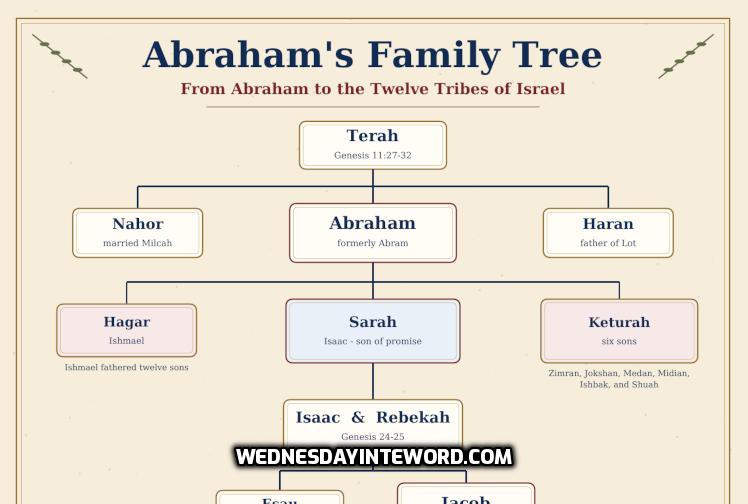
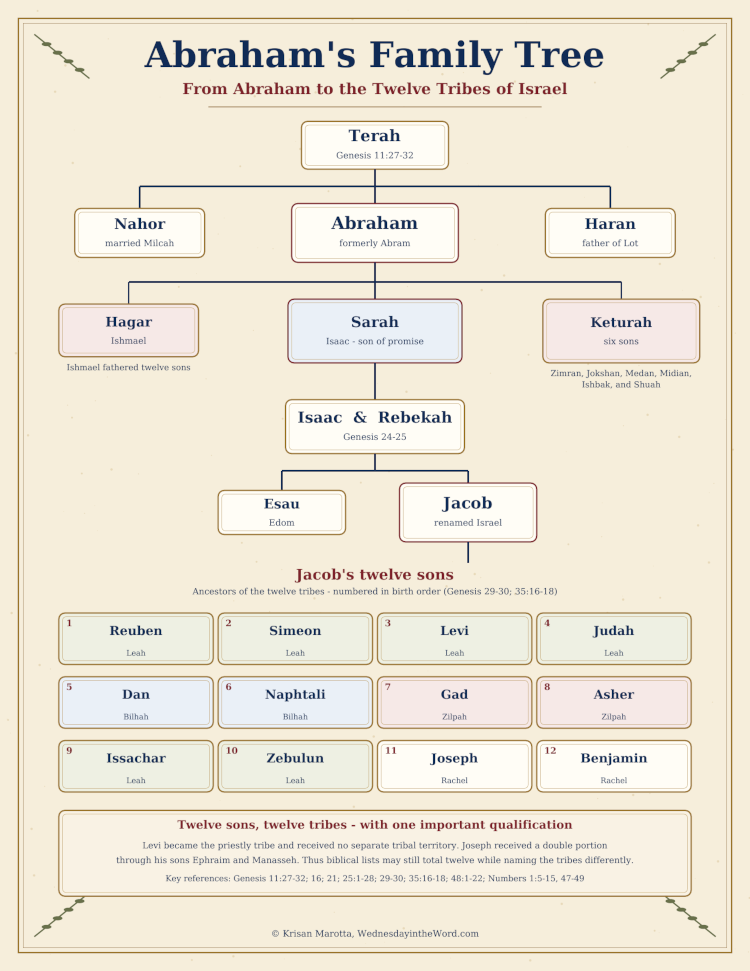
This chart shows Abraham’s extended family and traces the covenant line from Abraham through Isaac and Jacob to the twelve tribes of Israel.
Download a free PDF of Abraham's Family Tree Chart
Abraham’s Extended Family
Terah had 3 sons (Gen 11:27-32): Abram (Abraham), Nahor and Haran
- Abram (Abraham) married Sarai (Sarah), the daughter of Terah by a different mother (Genesis 20:12)
- Nahor married Milcah and had 7 sons including Bethuel (Genesis 22:20-24)
- Haran had 3 children: Milcah, Iscah and Lot.
Haran was the father of Lot, Milcah, and Iscah. After Haran died, Abraham traveled with his nephew Lot from Ur toward Canaan (Genesis 11:27–31). Lot has 2 daughters (Genesis 19).
Nahor married his niece Milcah, Haran’s daughter. They had eight sons, including Bethuel, who became the father of Rebekah and Laban (Genesis 22:20–23).
This means that Rebekah, whom Isaac later married, came from Abraham’s extended family. Rebekah’s brother Laban became the father of Leah and Rachel, the two principal wives of Jacob.
Abraham and Sarah
Abram married Sarai, whose name God later changed to Sarah. Abraham explained that Sarah was his half-sister: they had the same father but different mothers (Genesis 20:12).
God also changed Abram’s name to Abraham (Genesis 17:5).
God promised that Abraham would become the father of many nations and that kings would come from him. More specifically, God promised that the covenant line would continue through a son born to Sarah (Genesis 17:4–21).
Abraham’s Wives and Children
Abraham had children through Sarah, Hagar, and Keturah.
Hagar and Ishmael
When Sarah remained childless, she gave her Egyptian servant Hagar to Abraham. Hagar bore Abraham a son named Ishmael (Genesis 16:1–16).
God promised to bless Ishmael and make him fruitful. Ishmael became the father of twelve sons, who became twelve tribal princes (Genesis 17:20; 25:12–18).
Ishmael’s twelve sons should not be confused with Jacob’s twelve sons or the twelve tribes of Israel.
Sarah and Isaac
Sarah gave birth to Isaac when Abraham was one hundred years old. Isaac was the child God had promised, and God established his covenant with him (Genesis 17:19–21; 21:1–7).
The covenant line therefore continued:
Abraham → Isaac → Jacob
Keturah and Her Sons
After Sarah’s death, Abraham married Keturah. She bore him six sons:
- Zimran
- Jokshan
- Medan
- Midian
- Ishbak
- Shuah
These sons became ancestors of several peoples associated with the regions east and south of Canaan. The Midianites, who appear frequently later in Scripture, descended from Keturah’s son Midian (Genesis 25:1–6).
Before his death, Abraham gave gifts to the sons of his concubines and sent them eastward. He gave his primary inheritance to Isaac.
Isaac and Rebekah
Abraham sent his servant to his relatives in Mesopotamia to find a wife for Isaac. The servant returned with Rebekah, the granddaughter of Abraham’s brother Nahor (Genesis 24).
Isaac and Rebekah had twin sons:
- Esau
- Jacob
Although Esau was born first, God chose Jacob to receive the covenant promises. Before the twins were born, God told Rebekah: “The older shall serve the younger” (Genesis 25:23).
Esau and the Edomites
Esau was also called Edom, a name connected with the red stew for which he sold his birthright to Jacob (Genesis 25:29–34).
Esau became the ancestor of the Edomites, who settled in the hill country of Seir. Genesis 36 records Esau’s descendants and repeatedly identifies him as the father of Edom.
Jacob becomes Israel
God changed Jacob’s name to Israel after Jacob wrestled with him at Peniel: “Your name shall no longer be called Jacob, but Israel, for you have striven with God and with men, and have prevailed” (Genesis 32:28).
Jacob had twelve sons through Leah, Rachel, Bilhah, and Zilpah. Those sons became the ancestors of the tribes of Israel.
Jacob’s twelve sons in birth order
Leah bore Jacob six sons and at least one daughter:
- Reuben
- Simeon
- Levi
- Judah
- Issachar
- Zebulun
Their sister was Dinah. See Genesis 29:31–35; 30:17–21.
Rachel gave her servant Bilhah to Jacob. Bilhah bore (Genesis 30:1–8.:
- Dan
- Naphtali
Leah gave her servant Zilpah to Jacob. Zilpah bore (Genesis 30:9–13):
- Gad
- Asher
Rachel bore Jacob’s two youngest sons:
- Joseph
- Benjamin
Rachel died while giving birth to Benjamin (Genesis 35:16–20).
Joseph’s 2 sons, Manasseh and Ephraim inherit Joseph’s portion in the land (Genesis 48:5).
How did Jacob’s sons become the twelve tribes?
Each of Jacob’s twelve sons became the ancestor of an Israelite tribe. We might therefore expect every list of the tribes to contain the same twelve names. But the biblical lists vary according to their purpose.
Two special arrangements explain most of the differences.
Levi received no ordinary tribal territory
The tribe of Levi was set apart for service connected with the tabernacle and later the temple. Instead of receiving one large territory, the Levites received cities scattered throughout Israel (Numbers 18:20–24; Joshua 21).
Joseph received a double portion
Jacob adopted Joseph’s two sons, Ephraim and Manasseh, as his own (Genesis 48:5). Consequently, Joseph’s inheritance was divided between two tribes: Ephraim and Manasseh.
When a passage lists the tribes according to their territorial inheritance, Levi may be omitted and Joseph may be represented by Ephraim and Manasseh. That produces twelve territorial allotments:
- Reuben
- Simeon
- Judah
- Issachar
- Zebulun
- Dan
- Naphtali
- Gad
- Asher
- Benjamin
- Ephraim
- Manasseh
In other contexts, Scripture may include Levi, list Joseph under his own name, or arrange the tribes differently. The expression “the twelve tribes” refers collectively to the nation descended from Jacob even when a particular list varies.
Who’s Who in Abraham’s Family
Lot
Lot was Abraham’s nephew, the son of Abraham’s brother Haran. He traveled with Abraham to Canaan but later settled near Sodom. Through his daughters, Lot became the ancestor of the Moabites and Ammonites (Genesis 11:27–31; 13; 19:30–38).
Ishmael
Ishmael was Abraham’s son by Hagar. Although he was not the son through whom the covenant continued, God heard Hagar’s distress and promised to make Ishmael into a great nation (Genesis 16; 17:20; 21:8–21).
Isaac
Isaac was Abraham and Sarah’s promised son. God confirmed his covenant promises to Isaac, including the promises of descendants, land, and blessing (Genesis 21:1–7; 26:1–5).
Rebekah
Rebekah was Isaac’s wife, Bethuel’s daughter, and Laban’s sister. She was also a granddaughter of Abraham’s brother Nahor. Rebekah became the mother of Esau and Jacob (Genesis 22:20–23; 24; 25:19–28).
Esau
Esau was Isaac’s older son and Jacob’s twin brother. He sold his birthright to Jacob and later became the ancestor of the Edomites (Genesis 25:29–34; 36:1).
Jacob
Jacob was Isaac’s younger son. God renamed him Israel and confirmed the covenant promises given to Abraham and Isaac. Jacob’s twelve sons became the ancestors of the tribes of Israel (Genesis 28:10–17; 32:28; 35:9–12).
Joseph
Joseph was Jacob’s eleventh son and Rachel’s firstborn. His brothers sold him into slavery, but God raised him to power in Egypt and used him to preserve Jacob’s family during a famine. Joseph’s sons, Ephraim and Manasseh, each received a tribal inheritance (Genesis 37–50).
From Abraham to the Nation of Israel
The central line of the family tree is:
Abraham → Isaac → Jacob, also called Israel → the twelve sons → the tribes of Israel
God’s promise to Abraham was larger than one family’s prosperity. God chose Abraham and his descendants as part of his plan to bring blessing to all nations (Genesis 12:3).
The New Testament identifies Jesus as the promised offspring of Abraham through whom that blessing ultimately comes (Matthew 1:1; Galatians 3:16).
Genesis Bible Study Resources
Overview of the Pentateuch
Page Views: 7,908