
Updated October 2026
Keeping the kings of Israel and Judah straight can be confusing. Both kingdoms have a King Ahaziah and a King Jehoram. Two kings are named Jeroboam. Several kings have more than one name. And sometimes the same king appears in both Kings and Chronicles.
To make matters more complicated, Israel and Judah existed side by side for more than 200 years, with different kings ruling at the same time.
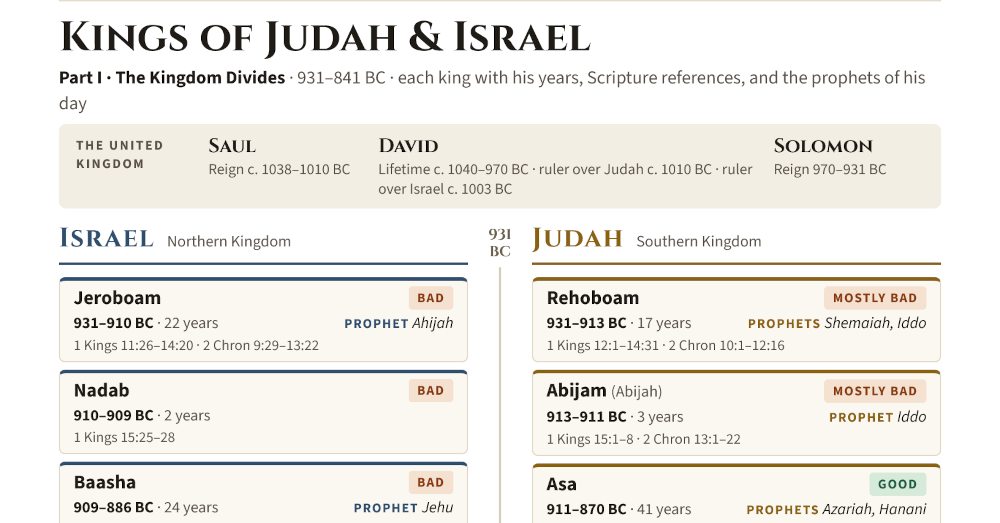
This chart brings the information together in one place. It lists the kings of Israel and Judah, their approximate reign dates, the biblical evaluation of their reigns, and the Scripture passages where you can read their stories.
You can use it as a quick reference while studying 1–2 Kings, 1–2 Chronicles, or the Old Testament prophets.
Download a free PDF of the Kings of Israel & Judah as a chart
From One Kingdom to Two
Israel began as a united kingdom under three kings: Saul, David, and Solomon.
Saul’s reign c. 1050/1030-1010 BC ; 1 Samuel 9-31
David’s lifetime c. 1040 -970 BC; 1 Samuel 16-1 Kings 2; 1 Chronicles 11-29
- ruler over Judah begins circa 1010 BC;
- ruler over all Israel begins circa 1003 BC
Solomon’s reign 970 -931 BC; 1 Kings 1-11; 2 Chronicles 1-9.
After Solomon died, his son Rehoboam inherited the throne. When Rehoboam refused to ease the burdens Solomon had placed on the people, ten northern tribes rebelled and made Jeroboam, son of Nebat, their king (1 Kings 12).
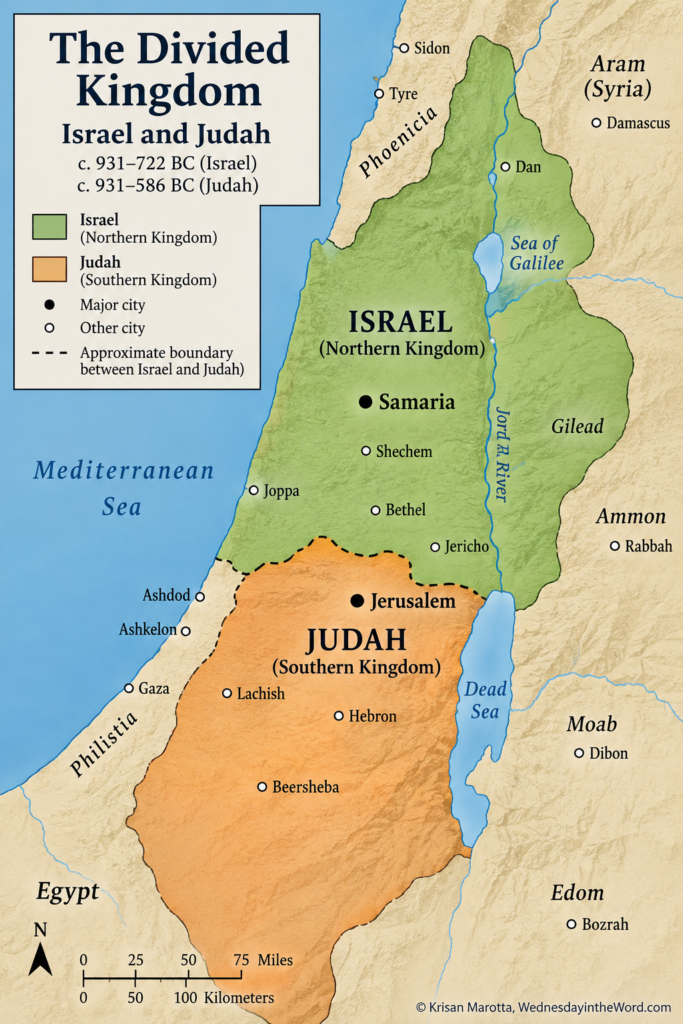
From that point forward, the nation was divided into two kingdoms.
- Israel (Northern Kingdom): The northern tribes followed Jeroboam.
- Judah (Southern Kingdom): The house of David continued to rule from Jerusalem, with Judah and Benjamin forming the core of the southern kingdom.
Both kingdoms experienced periods of prosperity and decline. Both repeatedly struggled with idolatry and disobedience. Both received warnings from God's prophets.
Key Dates in the History of Israel and Judah
- c. 1010 BC David becomes king of Judah.
- c. 1003 BC David becomes king over all Israel.
- c. 970 BC Solomon succeeds David.
- 931 BC The kingdom divides into Israel and Judah.
- 722 BC Assyria conquers Samaria and ends the Northern Kingdom.
- 597 BC Babylon captures Jerusalem and deports King Jehoiachin and others.
- 586 BC Babylon destroys Jerusalem and the temple.
- 539 BC Cyrus of Persia conquers Babylon.
- 538 BC Persian rule allows Jewish exiles to begin returning to Judah.
How to Read the Lists
Reign dates are approximate. Ancient chronology is complicated. Different reference works sometimes give slightly different dates, especially when a father and son ruled together for part of their reigns (a co-regency). The dates below provide a consistent general timeline.
Reign lengths and calendar dates do not always match. The biblical writers sometimes counted part of a year as a full year, and some reigns overlapped.
Good and evil describe biblical evaluations. The books of Kings and Chronicles assess rulers primarily according to their faithfulness to the Lord, their obedience to his covenant, and their response to idolatry. Some kings began well but ended badly, or the reverse.
Prophetic connections require care. Some prophets directly confronted particular kings. Others preached during the same general historical period. A prophet's approximate dates do not necessarily mean he personally advised every king who ruled during his lifetime.
Israel (Northern Kingdom)
The Northern Kingdom had 19 kings from several different dynasties. Unlike Judah, Israel did not maintain one continuous royal family.
The biblical writers evaluate every northern king negatively because none permanently rejected the idolatrous worship system Jeroboam established (1 Kings 12:26–33). Some, like Jehu, nevertheless carried out particular commands from God.
King, biblical evaluation, approximate reign, main Scripture, Prophet(s)
Jeroboam – bad; 931-910 BC; 22 years; Scripture: 1 Kings 11:26-14:20; 2 Chronicles 9:29-13:22; Prophet: Ahijah (1 Kings 11:28-30).
Nadab – bad; 910-909 BC; 2 years; 1 Kings 15:25-28.
Baasha – bad; 909-886 BC; 24 years; 1 Kings 15:27-16:7; 2 Chronicles 16:1-6; Prophet: Jehu (1 Kings 16).
Elah – bad; 886-886 BC; 2 years; 1 Kings 16:8-10.
Zimri – bad; 886 BC; 7 days; 1 Kings 16:10-20; Prophet: Jehu (1 Kings 16:11-13).
Omri – evil; 885-874 BC; 12 years; 1 Kings 16:16-27; Prophet: Elijah.
Ahab - among the worst; 874-853 BC; 22 years; 1 Kings 16:28-22:40; 2 Chronicles 18:1-13: Prophets: Elijah & Micaiah
Ahaziah – bad; 853-852 BC; 2 years; 1 Kings 22:40, 51-53; 2Kings 1:1-17; 2 Chronicles 20:35-37; Prophets: Elijah & Elisha.
Joram (Jehoram) – bad; 852-841 BC; 12 years; 2 Kings 3:1-3; 2 Kings 9:14-25; 2 Chronicles 22:5-7; Prophet: Elisha.
Jehu - mostly bad; 841-814 BC; 28 years; 2 Kings 9-10; 2 Chronicles 22:7-12; Prophet: Elisha.
Jehoash (Joash) – bad; 798-782 BC; 16 years; 2 Kings 13:10-25; 2 Chronicles 25:17-24: Prophet: Jonah.
Jeroboam II – bad; 782-753 BC; 41 years; 2 Kings 14:23-29; Prophets: Amos, Jonah.
Zechariah – bad; 753-752 BC; 6 months; 2 Kings 15:8-12; Prophet: Hosea.
Shallum – bad; 752 BC; 1 month; 2 Kings 15:13-15; Prophet: Hosea.
Menahem – bad; 752-742 BC; 10 years; 2 Kings 15:16-22; Prophet: Hosea.
Pekahiah – bad; 742-740 BC; 2 years; 2 Kings 15:23-26; Prophet: Hosea.
Pekah - bad; 742-740 BC; 20 years; 2Kings 15:27-31; 2 Chronicles 28:5-8; Prophet: Hosea
Note: Pekah's biblical reign length of 20 years includes a period of rival rule in some chronological reconstructions. The approximate dates above reflect his later rule over Israel.
Hoshea – bad; 732-722 BC; 9 years; 2 Kings 17:1-41; Prophet: Hosea.
Fall of Samaria 722 BC 10 northern tribes taken in captivity in Assyria
The Fall of Israel
In 722 BC, Assyria conquered Samaria, bringing the Northern Kingdom to an end. Many Israelites were deported, and Assyria resettled people from other regions in the land.
2 Kings 17 explains the fall of Israel primarily in spiritual terms. The nation repeatedly rejected God's covenant, worshiped other gods, and refused to listen to the prophets God sent to warn them.
Read the account: 2 Kings 17.
Judah (Southern Kingdom)
Judah had 19 kings and one queen who seized the throne. With the exception of Athaliah's interruption, its rulers belonged to the dynasty of David.
Some kings of Judah followed the Lord and attempted to reform the nation's worship. Others promoted idolatry. Even the most faithful kings could not permanently reverse the nation's decline.
King, biblical evaluation, approximate reign, main Scripture, Prophet(s)
Rehoboam – mostly bad; 931-913 BC; 17 years; 1 Kings 12:1-14:31; 2 Chronicles 10:1-12:16; Prophets: Shemaiah (1 Kings 12); Iddo (2 Chronicles 12:14-16).
Abijam (Abijah) – mostly bad; 913-911 BC;3 years; 1 Kings 15:1-8; 2 Chronicles 13:1-22; Prophet: Iddo.
Asa – good; 911-870 BC; 41 years; 1 Kings 15:9-24; 2 Chronicles 14:1-16:14; Prophets: Azariah (2 Chronicles 15); Hanani (2 Chronicles 16).
Jehoshaphat - good; 873-848 BC; 25 years; 1 Kings 22:41-50; 2 Chronicles 17:1-21:1; Prophets: Jehu; Jahaziel, Eliezer
Jehoram – bad; 848-841 BC; 8 years; 2 Kings 8:16-24; 2 Chronicles 21:1-20; Prophet: Obadiah?? (dates of Obadiah are unknown)
Ahaziah – bad; 841 BC; 1 year; 2 Kings 8:25-29; 2 Kings 9:27-29; 2 Chronicles 22:1-9.
Athaliah (Queen) – wicked; 841-835 BC; 6 years; 2 Kings 8:25-28; 2 Kings 11:1-20; 2 Chronicles 22:10-23:21.
Joash – mostly good; 835-796 BC; 40 years; 2 Kings 11:1-12:21; 2 Chronicles 23:1-24:27; Prophet: Joel.
Amaziah – mostly good; 796-767 BC; 29 years; 2 Kings 14:1-14; 2 Chronicles 25:1-28.
Uzziah (Azariah) – good; 767-740 BC; 52 years; 2 Kings 15:1-7; 2 Chronicles 26:1-23.
Jotham – good; 740-731 BC; 16 years; 2 Kings 15:32-38; 2 Chronicles 27:1-9; Prophet: Isaiah.
Ahaz – wicked; 731-715 BC; 16 years; 2 Kings 16:1-20; 2 Chronicles 28:1-27; Prophets: Isaiah & Micah.
The reigns of Uzziah, Jotham, and Ahaz included overlapping periods of rule. Uzziah's total reign is recorded as 52 years, although the dates shown above focus on his later period as sole ruler.
Hezekiah – among best; 715-686 BC; 29 years; 2 Kings 18-20; 2 Chronicles 29-32; Prophets: Isaiah & Micah.
Manasseh – among worst; 686-642 BC; 55 years; 2 Kings 21; 2 Chronicles 33; Prophets: Isaiah & Nahum.
Amon – among worst; 642-640 BC; 2 years; 2 Kings 21:19-23; 2 Chronicles 33:21-25; Prophets: Nahum, Zephaniah, Habakkuk.
Josiah -among best; 640-609 BC; 31 years; 2 Kings 22-23:30; 2 Chronicles 34:1-35:27; Prophets: Nahum, Zephaniah, Habakkuk, Jeremiah, Huldah.
Jehoahaz (Shallum) – bad; 609 BC; 3 months; 2 Kings 23:31-33; 2 Chronicles 36:1-4; Prophets: Habakkuk, Jeremiah.
Jehoiakim (Eliakim) – wicked; 609-598 BC; 11 years; 2 Kings 23:34-24:5; 2 Chronicles 36:5-8; Prophets: Daniel, Habakkuk, Jeremiah, Ezekiel.
Jehoiachin – bad; 598 -597 BC; 3 months; 2 Kings 24:6-16; 2 Chronicles 36:8-10: Prophets: Daniel, Jeremiah, Ezekiel.
Zedekiah – bad; 597-586 BC; 11 years; 2 Kings 24:17-25:7; 2 Chronicles 36:11-21; Prophets: Daniel, Jeremiah, Ezekiel.
Fall of Jerusalem 586 BC (siege begins 588 BC); 2 southern tribes taken in captivity to Babylon
The dates of Joel, Obadiah, and some other prophets are debated, so they cannot be assigned confidently to individual kings.
The Fall of Judah
Judah survived the destruction of the Northern Kingdom, but its rulers and people continued to struggle with idolatry and disobedience.
During Josiah's reign, the discovery of the Book of the Law led to widespread religious reform (2 Kings 22–23). However, those reforms did not permanently change the nation.
Babylon became the dominant regional power. Jerusalem suffered multiple invasions and deportations, culminating in the destruction of the city and temple in 586 BC.
The surviving people faced exile, but Judah's story did not end there. After Persia conquered Babylon in 539 BC, exiles began returning to Judah, rebuilding the temple and eventually Jerusalem's walls.
Read the account: 2 Kings 24–25; 2 Chronicles 36; Ezra 1.
What Makes a King Good or Evil in the Bible?
When reading Kings and Chronicles, we might expect a king to be judged by his military victories, economic prosperity, or political skill. But the biblical writers use a different standard.
They repeatedly ask whether a king did what was right in the eyes of the Lord, followed God's commandments, and rejected the worship of other gods. That explains some surprising evaluations.
Omri established a powerful dynasty and built Samaria as Israel's capital, yet the biblical text condemns his idolatry (1 Kings 16:25–26).
Jeroboam II restored Israel's territory and enjoyed considerable political success, but he continued the sins of the first Jeroboam (2 Kings 14:23–29).
Hezekiah and Josiah receive strong praise, not primarily for their military achievements, but for their faithfulness to the Lord and their efforts to restore proper worship (2 Kings 18:3–6; 23:25).
The contrast teaches us something important about the history of God's people. The central question is not simply whether a king made his nation prosperous. It is whether he led the people to trust and obey the Lord.
Where to Next
If you're studying the kings and prophets, these resources will help put their stories in context.
1&2 Kings Bible Study Resources: Outlines, maps, historical background, and study helps.
1&2 Chronicles Bible Study Resources: Parallel accounts and additional background on the kings of Judah.
Introduction to the Northern Kingdom: Background on Israel after the division.
Introduction to the Southern Kingdom: Background on the Davidic dynasty and Judah.
Overview of Biblical History: A larger timeline that puts the divided kingdom within the whole Old Testament story.
The books of Kings and Chronicles tell us what happened. The prophets help us understand what God was saying to his people while it happened.
Page Views: 7,339