

Updated September 2026
The New Testament took place in a real geographic world. Cities, roads, seas, political boundaries, and longstanding regional rivalries all influenced what happened.
Paul’s letters make more sense when you know that Corinth was a prosperous port city, Ephesus was the leading city of the Roman province of Asia, and Thessalonica stood on one of the empire’s most important roads. Jesus’ ministry also becomes clearer when you understand the differences among Galilee, Samaria, and Judea.
Use this guide as a biblical geography glossary whenever you encounter an unfamiliar place in the Gospels, Acts, or the New Testament letters.
Important Cities

Jerusalem - the religious capital of the Jewish world, and the site of the temple, Jesus' crucifixion and resurrection, and the birth of the church at Pentecost.
Alexandria - The commercial metropolis of Egypt, home to a large Jewish population and the city where the Hebrew Scriptures were translated into Greek as the Septuagint.
Antioch of Syria - The military and administrative center for that part of Galatia; Paul and Barnabas were commissioned from here for their first missionary journey (Acts 13:1-3).
The New Testament mentions two cities called Antioch:
- Antioch of Syria was the church that sent Paul and Barnabas on their missionary journey.
- Antioch of Pisidia was one of the cities where they preached during that journey.
Athens - The literary and philosophical center of Greece, where Paul reasoned with Stoic and Epicurean philosophers and preached his famous sermon in the Areopagus (Acts 17).
Bethlehem - The city of David, a few miles south of Jerusalem, where Christ was born in fulfillment of Micah's prophecy (Micah 5:2).
Caesarea - The Roman capital of Judea and headquarters of the Roman governor; Paul was imprisoned here for two years before appealing to Caesar (Acts 24-26).
Capernaum - The base of operations for Jesus' early Galilean ministry, where He healed the paralytic and called Matthew from his tax booth.
Corinth - The political capital of Greece and a notoriously immoral port city, where Paul spent a year and a half establishing the church he later wrote two letters to.
Damascus - in the southern part of Syria. This is the city Paul was traveling to, to arrest Christians, when he met the risen Christ (Acts 9). He later had to escape the city in a basket lowered over the wall (Acts 9:25, 2 Corinthians 11:33).
Ephesus - The leading city of the province of Asia and Paul's base of operations for his third missionary journey, later home to one of the seven churches of Revelation.
Nazareth - A small, unremarkable town in Galilee where Jesus grew up, so obscure that Nathanael doubted anything good could come from it (John 1:46).
Philippi - A Roman colony in Macedonia and the first city in Europe where Paul planted a church, beginning with Lydia's conversion by the riverside (Acts 16).
Rome - The imperial capital of the empire, where Paul was eventually brought as a prisoner and where he wrote several of his letters under house arrest.
Tarsus - The birthplace of Paul in the province of Cilicia, a city he later described as "no ordinary city" (Acts 21:39).
Thessalonica - The principal city of Macedonia, where Paul's brief ministry stirred up enough controversy that he had to leave by night, later writing two letters back to the church there.
Regions in Palestine
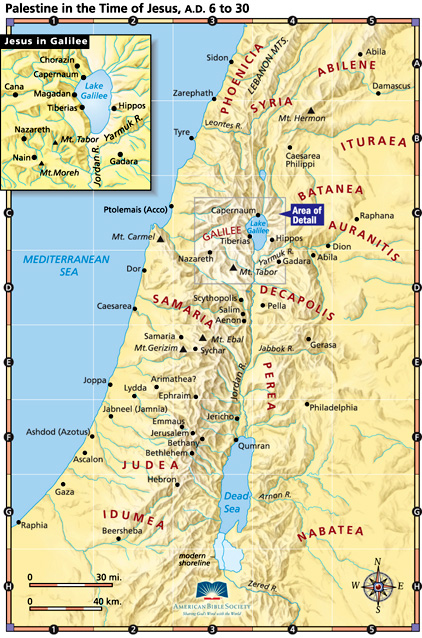
Judea - The southern region of Palestine centered on Jerusalem, home to the temple and the seat of the religious establishment; under direct Roman governance for most of Jesus' life, it's the region where His ministry ended.
Samaria - the region north of Judea. Most Jews of Jesus' day traveled around Samaria rather than through it, due to centuries of religious and ethnic hostility between Jews and Samaritans. Jesus went straight through it instead, and met the Samaritan woman at the well (John 4). Who were the Samaritans?
Galilee - The northern region where Jesus grew up and spent most of His public ministry, looked down on by the Judean religious leaders as a rural backwater ("can anything good come out of Nazareth?" John 1:46), yet it's where He called His disciples, worked most of His miracles, and taught the bulk of what we know as His teaching.
Decapolis - the league of 10 cities east of the sea of Galilee. These were largely Greek cities, culturally distinct from Jewish Galilee. Jesus ministered here more than once (Mark 5:20, Mark 7:31).
Idumea - the region south of Judea. This was the ancestral home of the Edomites and of Herod the Great's family. Mark notes that crowds came to Jesus from Idumea along with Judea and Galilee (Mark 3:8).
Provinces
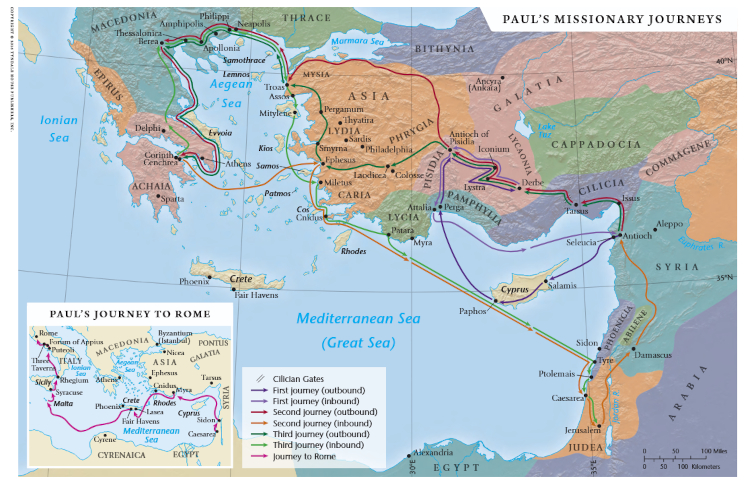
Map caption: The Romans organized their empire into provinces. Several familiar New Testament names refer to political territories rather than individual cities.
A note about political names: Some names changed meaning depending on the period or the writer. A name might identify a Roman province, an older ethnic region, or a broader geographic territory. Context determines which meaning is intended.
Macedonia - the land at the northeast corner of the Aegean Sea, in-between Thrace, Illyricum, and Greece.
Achaia (Greece) - the land southwest of Macedonia, bordering 3 seas.
Illyricum - the land north of Greece, northwest of Macedonia, and the eastern portion of the Adriatic Sea. Paul says he preached the gospel all the way to this region's border (Romans 15:19).
Italy - the country across the Adriatic Sea from Greece and Illyricum. Rome was the capital of Italy.
Egypt - the land at the southeast of the Mediterranean Sea. Joseph and Mary fled here with the infant Jesus to escape Herod's massacre of the children of Bethlehem (Matthew 2:13-15).
Asia - the land in the western region of Asia Minor (Ancient Turkey).
Pontus and Bithynia were the areas in northern region of Asia Minor. Along with Galatia, Cappadocia, and Asia, these are named as home to the scattered believers Peter writes to in 1 Peter 1:1.
Galatia - the area in the region of central Asia Minor. Much of Paul's first missionary journey (Acts 13-14) took place here, and it's the audience of his letter to the Galatians.
Cappadocia was the land south of Galatia in eastern Asia Minor. Also named in 1 Peter 1:1.
Cilicia - a province in southeast Asia Minor, below Cappadocia. This is the province containing Tarsus, Paul's hometown.
Syria -the land north of Israel bordering the Mediterranean Sea.
Seas, Rivers & Islands
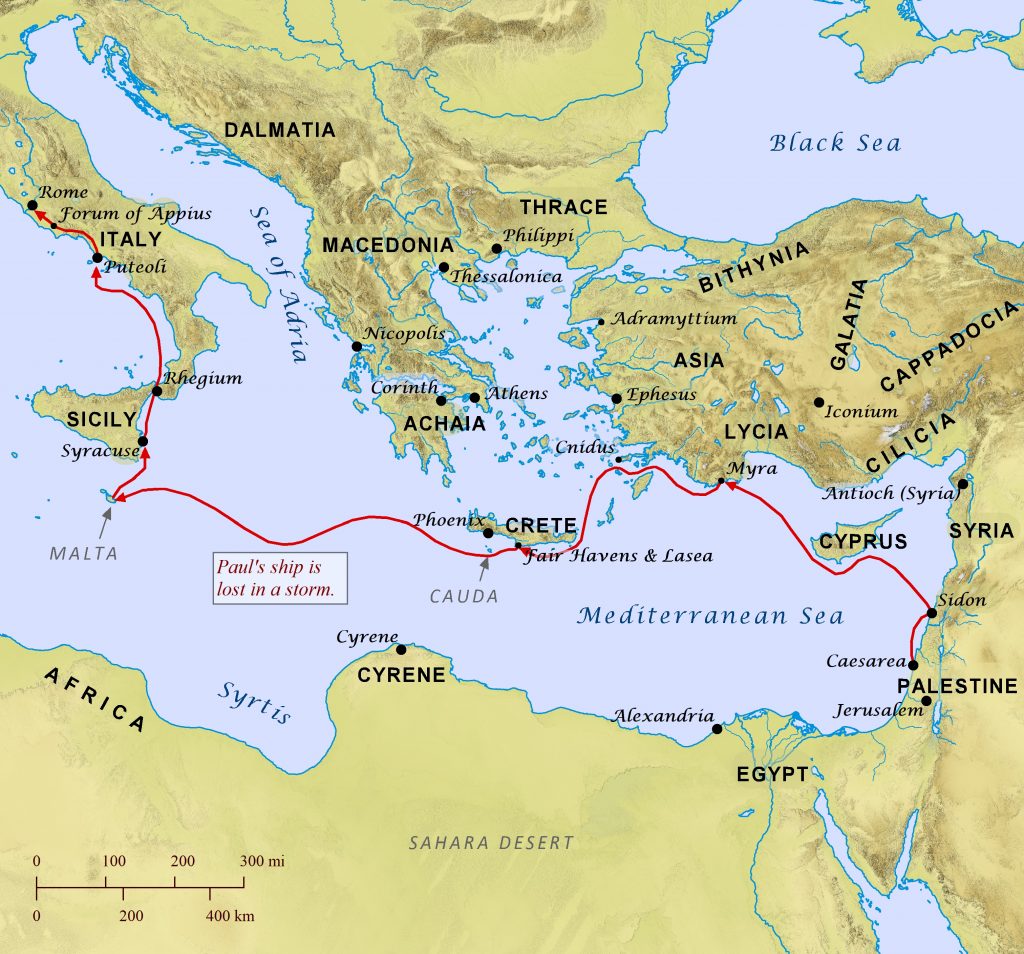
Map caption: Seas and islands shaped travel throughout the New Testament world. Paul’s journeys depended on Mediterranean shipping routes as well as Roman roads.
The Great Sea (Mediterranean) - borders the land of Israel on the east as far as Italy on the west.
The Sea of Galilee, also called the Sea of Tiberias, in the Jordan valley.
Jordan River - runs through Palestine.
The Adriatic Sea - located between Greece and Italy.
The Aegean Sea, located between Asia Minor and Greece.
Cyprus - located in the northeast corner of the Mediterranean Sea.
Crete - located south of the Aegean Sea, between Asia Minor and Greece.
Patmos - located in the Aegean Sea, not far from the city of Ephesus.
Malta or Melita in NT times, located south of Sicily.
Sicily located southwest of Italy. Paul's ship stopped at Syracuse, on Sicily's coast, for three days on the voyage to Rome (Acts 28:12).
Common Questions
Why does Bible geography matter if I'm not a scholar?
Because the biblical writers assumed their first readers knew this map cold. When Paul says he's headed to Macedonia, or Peter writes to believers scattered across five provinces, that's not incidental detail. It's part of how the original audience understood the size, spread, and cost of the early church's mission. You're not required to memorize it, but a rough mental map turns flat names into a real, three-dimensional world.
What's the difference between a region, a province, and a city in this list?
- Cities are single locations (Ephesus, Corinth).
- Regions are older, more informal areas tied to ethnic or historical identity (Galilee, Samaria, Idumea).
- Provinces are the official Roman administrative units layered on top of those regions (Asia, Galatia, Syria). One province, like Asia, could contain several cities and older regional names inside it.
Where should I start if this is my first time working through New Testament geography?
Start with the "Important Cities" list and just note which ones show up in whatever book you're currently studying. You don't need the whole map at once. You need the handful of places that matter for the passage in front of you.
Does “Asia” mean the modern continent?
Usually not. In the New Testament, Asia ordinarily refers to the Roman province occupying part of western Asia Minor, in modern Turkey. It included Ephesus and the seven churches addressed in Revelation 2–3.
Where should I start?
If you are reading the Gospels, begin with Galilee, Samaria, Judea, Jerusalem, Capernaum, and the Sea of Galilee.
If you are reading Acts, trace the movement described in Acts 1:8: Jerusalem, Judea, Samaria, and then outward through Syria, Asia Minor, Macedonia, Achaia, and Rome.
If you are reading Paul’s letters, locate the receiving church and ask:
- Was it located in a Jewish or predominantly Gentile setting?
- Was it a provincial capital, commercial center, port, or Roman colony?
- How might the city’s culture help explain the issues addressed in the letter?
Summary
The New Testament happened in specific cities, under specific provinces, along specific coastlines and rivers. Keep this list handy as you read through the Gospels, Acts, and the epistles, and the places will stop being names to skim past and start being part of the story.
Top Banner Map from Bible-history.com
Page Views: 11,313