
Updated October 2026
After the death of King Solomon, his son Rehoboam inherited the throne. When Rehoboam refused to lighten the heavy burdens Solomon had placed on the people, ten northern tribes rebelled and made Jeroboam, a former official under Solomon, their king. The northern tribes became the kingdom of Israel, while Judah and Benjamin remained loyal to Rehoboam, forming the Southern Kingdom of Judah (1 Kings 12:1–24).
For the next 209 years, Israel was ruled by 19 kings from several different families. Unlike Judah, where David's descendants maintained the throne, Israel experienced repeated changes of dynasty through assassination, rebellion, and military coups.
Some northern kings strengthened the nation politically or economically. Others brought considerable suffering. But the biblical writers evaluate every king negatively because none abandoned the idolatrous worship system established by Jeroboam.
The history of the Northern Kingdom is recorded primarily in 1–2 Kings. It provides the historical setting for the ministries of Elijah, Elisha, Amos, Hosea, and other prophets who warned Israel to return to the Lord.
This overview follows Israel's kings chronologically, highlighting the political events, spiritual condition, and biblical passages associated with each reign.
The Northern Kingdom at a Glance
- Name: Israel, also called the Northern Kingdom or Ephraim
- Dates: Approximately 931–722 BC
- Capitals: Initially Shechem and Tirzah; later Samaria
- Tribes: The northern tribes of Israel, traditionally described as ten tribes
- Royal dynasty: Several dynasties, frequently replaced by coups
- Number of kings: 19
- Primary Scripture: 1 Kings 12–2 Kings 17
- Major prophets: Ahijah, Elijah, Elisha, Jonah, Amos, Hosea
- Major enemies:Judah, Aram (Syria), Assyria
- End of kingdom: Samaria conquered by Assyria in 722 BC
Key Dates in Israel's History
- 931 BC The united kingdom divides into Israel and Judah; Jeroboam becomes king of Israel.
- c. 909 BC Baasha kills Nadab and destroys Jeroboam's royal family.
- c. 885 BC Omri gains the throne after a period of civil conflict.
- c. 880 BC Omri establishes Samaria as Israel's new capital.
- 874–853 BC Ahab reigns and promotes Baal worship alongside his wife Jezebel.
- 841 BC Jehu kills Joram and destroys Ahab's dynasty.
- 782–753 BC Israel enjoys territorial expansion and prosperity under Jeroboam II.
- 753–752 BC Zechariah's assassination ends Jehu's dynasty.
- 743/742 BC Menahem pays tribute to Tiglath-pileser III of Assyria.
- 734–732 BC Assyria captures northern territory and deports many Israelites.
- 732 BC Hoshea becomes Israel's last king.
- 722 BC Samaria falls to Assyria, ending the Northern Kingdom.
A note about dates: Ancient chronologies sometimes differ by a few years. Reign lengths may include partial years, periods of rival rule, and overlapping reigns. The dates in this overview are approximate.
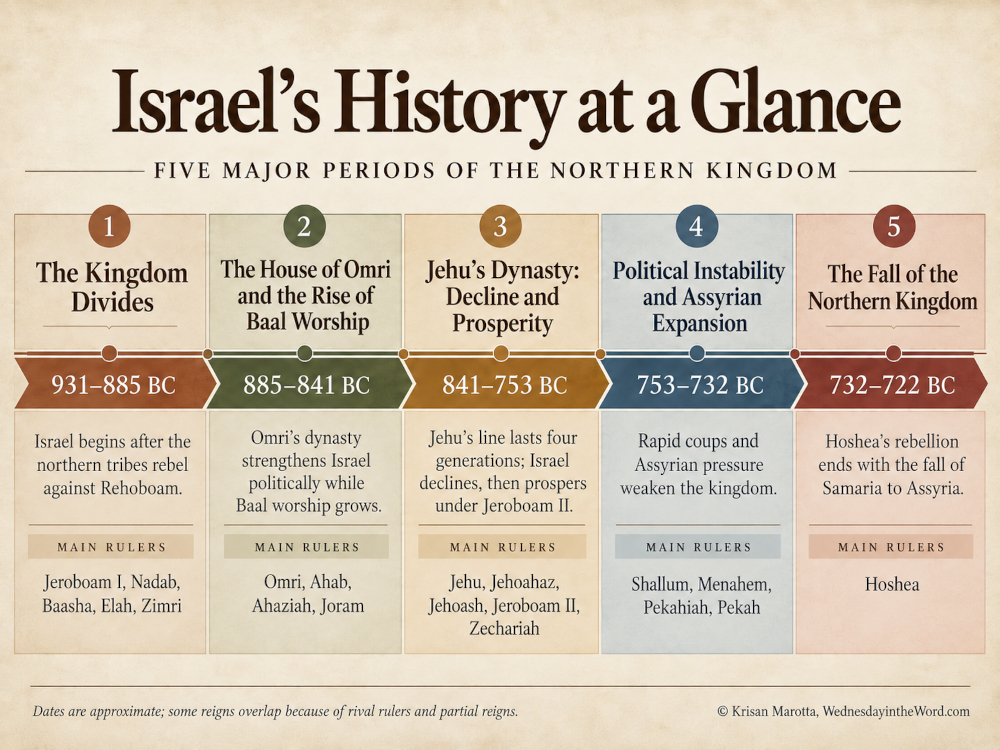
1. The Kingdom Divides (931–885 BC)
Kings: Jeroboam I, Nadab, Baasha, Elah, Zimri
The Northern Kingdom began with a rebellion against Solomon's son Rehoboam.
Solomon had expanded Israel's wealth and influence, but his building projects and royal administration placed heavy demands upon the people. When the northern tribes asked Rehoboam to ease those burdens, he refused.
The northern tribes rebelled and chose Jeroboam as their king.
Jeroboam faced an immediate problem. Jerusalem, where the temple stood, was now in the rival kingdom of Judah. If his people continued traveling to Jerusalem to worship, they might eventually renew their loyalty to Rehoboam.
His solution would shape the religious history of Israel for the next two centuries.
Jeroboam I (931–910 BC)
Scripture: 1 Kings 11:26–14:20
- Jeroboam was the son of Nebat and a former official under Solomon.
- The prophet Ahijah announced that God would give Jeroboam rule over ten tribes because of Solomon's unfaithfulness (1 Kings 11:29–39).
- After the northern tribes rebelled against Rehoboam, Jeroboam became their first king.
- He fortified Shechem and Penuel to strengthen his new kingdom.
- Fearing that worship in Jerusalem would undermine his authority, he established alternative worship centers at Bethel and Dan.
- He placed golden calves at those centers, appointed his own priests, and established a religious festival.
- A prophet condemned the altar at Bethel, and Ahijah later announced judgment against Jeroboam's family.
- His religious policies became the standard by which the biblical writers condemned later northern kings.
Key point: Jeroboam received the kingdom from God but refused to trust God to preserve it. His attempt to secure his throne through unauthorized worship led Israel into generations of idolatry.
Nadab (910–909 BC)
Scripture: 1 Kings 15:25–31
- Nadab succeeded his father Jeroboam.
- He continued the sins of his father, maintaining the idolatrous worship system Jeroboam established.
- While besieging the Philistine city of Gibbethon, Nadab was assassinated by Baasha.
- Baasha then killed the remaining members of Jeroboam's royal family.
Key point: Nadab continued his father's religious policies but could not preserve his dynasty. His assassination fulfilled Ahijah's warning of judgment against Jeroboam's house (1 Kings 14:10–11).
Baasha (909–886 BC)
Scripture: 1 Kings 15:27–16:7
- Baasha was the son of Ahijah from the tribe of Issachar.
- After killing Nadab, he destroyed Jeroboam's descendants and established a new dynasty.
- He fought continually against Asa, king of Judah.
- He fortified Ramah to restrict movement between Israel and Judah.
- Asa responded by paying Ben-hadad of Aram to attack Israel, forcing Baasha to abandon his construction project.
- Although Baasha had destroyed Jeroboam's family, he continued Jeroboam's idolatrous practices.
- The prophet Jehu son of Hanani announced that Baasha's dynasty would suffer the same fate as Jeroboam's.
Key point: Baasha became king by destroying a dynasty condemned for idolatry, but he repeated the same sins and brought similar judgment upon his own family.
Elah (886–885 BC)
Scripture: 1 Kings 16:8–14
- Elah succeeded his father Baasha.
- He continued the evil practices of his predecessors.
- While drinking in the house of one of his officials at Tirzah, he was assassinated by Zimri, one of his military commanders.
- Zimri destroyed the remaining members of Baasha's family.
Key point: Elah's assassination fulfilled the prophetic warning against Baasha's dynasty and continued the pattern of political violence in Israel.
Zimri (885 BC; seven days)
Scripture: 1 Kings 16:9–20
- Zimri seized the throne after killing Elah.
- He eliminated Baasha's descendants to secure his position.
- When Israel's army learned of the coup, the soldiers proclaimed their commander Omri king.
- Omri marched against Tirzah and besieged the city.
- When Zimri realized the city had fallen, he set fire to the royal palace and died inside.
- His reign lasted only seven days.
Key point: Zimri gained the throne through assassination but held it for only a week. The violence that established one dynasty repeatedly became the means of destroying it.
2. The House of Omri and the Rise of Baal Worship (885–841 BC)
Kings: Omri, Ahab, Ahaziah, Joram
Omri established one of the most politically significant dynasties in Israel's history.
He built a new capital at Samaria and strengthened the kingdom's position among neighboring nations. His son Ahab continued that political expansion through military campaigns and foreign alliances.
But Ahab's marriage to Jezebel, daughter of the king of the Sidonians, brought royal sponsorship of Baal worship into Israel.
During this period, the prophet Elijah confronted Ahab and Jezebel, demonstrating that the Lord, not Baal, controlled the rain, the harvest, and the fate of the nation.
Elisha continued that prophetic ministry after Elijah.
Omri (885–874 BC)
Scripture: 1 Kings 16:16–28
- Omri was commander of Israel's army when the soldiers proclaimed him king after Zimri's rebellion.
- He faced a rival claimant, Tibni son of Ginath, before finally securing the throne.
- He purchased a hill from Shemer and built the city of Samaria, making it Israel's capital.
- Samaria remained the capital of the Northern Kingdom until its destruction in 722 BC.
- Omri established a powerful dynasty that became important in the politics of the region.
- Despite his political accomplishments, the biblical writer says he did more evil than those who preceded him.
Key point: Omri strengthened Israel politically but did not lead the nation toward covenant faithfulness. The biblical writers judged his reign by a different standard than political success.
Ahab (874–853 BC)
Scripture: 1 Kings 16:29–22:40; 2 Chronicles 18
- Ahab succeeded his father Omri and continued expanding Israel's political influence.
- He married Jezebel, daughter of Ethbaal, king of the Sidonians.
- Ahab built a temple and altar for Baal in Samaria.
- Elijah announced a drought as judgment against Israel's idolatry (1 Kings 17).
- At Mount Carmel, Elijah challenged the prophets of Baal, and the Lord answered by sending fire from heaven (1 Kings 18).
- Ahab defeated Ben-hadad of Aram in several military campaigns, although he failed to obey God's instructions concerning Ben-hadad (1 Kings 20).
- Ahab desired Naboth's vineyard, and Jezebel arranged Naboth's death so Ahab could take possession of it.
- Elijah condemned Ahab for this injustice and announced judgment against his family (1 Kings 21).
- Ahab was killed during a battle against Aram at Ramoth-gilead.
Key point: Ahab enjoyed considerable political power, but his promotion of Baal worship and abuse of royal authority brought God's condemnation. His reign also provides the setting for some of Elijah's most important confrontations.
Ahaziah (853–852 BC)
Scripture: 1 Kings 22:51–53; 2 Kings 1
- Ahaziah succeeded his father Ahab.
- He continued the worship of Baal established under his parents.
- Moab rebelled against Israel during his reign.
- After falling through the lattice of an upper room, Ahaziah suffered a serious injury.
- Rather than inquire of the Lord, he sent messengers to consult Baal-zebub, the god of Ekron.
- Elijah intercepted the messengers and announced that Ahaziah would die.
- Ahaziah died without a son, and his brother Joram succeeded him.
Key point: Ahaziah's decision to seek help from a foreign god rather than the Lord illustrates how deeply Baal worship had influenced Israel's royal family.
Joram (Jehoram) (852–841 BC)
Scripture: 2 Kings 3; 6:24–7:20; 8:16–9:26
- Joram succeeded his brother Ahaziah.
- He removed a sacred pillar of Baal erected by his father, but continued the worship practices Jeroboam had established.
- He joined Jehoshaphat of Judah and the king of Edom in a military campaign against Moab.
- Elisha announced that God would provide water for the armies and grant them victory (2 Kings 3).
- Joram's reign included continuing conflict with Aram and a devastating siege of Samaria.
- During these conflicts, Elisha repeatedly demonstrated the Lord's power and knowledge.
- Joram later joined Ahaziah, king of Judah, in battle against Hazael of Aram.
- Jehu assassinated Joram during a military revolt, bringing Omri's dynasty to an end.
Key point: Joram made limited changes to the worship of Baal, but he never abandoned the deeper problem of Israel's false worship. His death fulfilled the judgment announced against Ahab's house.
3. Jehu's Dynasty: Decline and Prosperity (841–753 BC)
Kings: Jehu, Jehoahaz, Jehoash, Jeroboam II, Zechariah
Jehu came to power with a divine commission to destroy the house of Ahab.
He eliminated Ahab's descendants and the worship of Baal, but he did not remove the golden calves at Bethel and Dan.
God promised that Jehu's descendants would occupy Israel's throne for four generations (2 Kings 10:30). This became Israel's longest-lasting royal dynasty after the kingdom divided.
During these years, Israel suffered serious defeats at the hands of Aram. Later, under Jeroboam II, the kingdom experienced renewed prosperity and territorial expansion.
But the prophets Amos and Hosea warned that outward prosperity concealed widespread injustice, idolatry, and covenant unfaithfulness.
Jehu (841–814 BC)
Scripture: 2 Kings 9–10
- Elisha sent one of the sons of the prophets to anoint Jehu king of Israel.
- Jehu led a military revolt against Joram and killed him.
- Jehu also killed Ahaziah, king of Judah, who was visiting Joram.
- He ordered Jezebel's death and destroyed the surviving members of Ahab's family.
- Through deception, Jehu gathered the worshipers of Baal into their temple and had them killed.
- He destroyed the temple and pillar of Baal, ending its officially sponsored worship in Israel.
- However, Jehu continued to worship the golden calves at Bethel and Dan.
- The Lord promised that Jehu's descendants would rule Israel for four generations.
- During his reign, Hazael of Aram began taking territory from Israel.
Key point: Jehu carried out God's judgment against Ahab's house but failed to follow the Lord wholeheartedly. Destroying one form of idolatry did not make Israel faithful.
Jehoahaz (814–798 BC)
Scripture: 2 Kings 13:1–9
- Jehoahaz succeeded his father Jehu.
- He continued the sins of Jeroboam.
- Hazael and Ben-hadad of Aram repeatedly defeated Israel, greatly weakening its army.
- Jehoahaz sought the Lord's favor when Israel suffered under Aramean oppression.
- The Lord provided a deliverer, although the biblical writer does not identify that person.
- Despite receiving relief, Israel continued its idolatrous practices.
Key point: God showed compassion toward Israel when Jehoahaz sought his help, but the people did not respond with lasting repentance.
Jehoash (Joash) (798–782 BC)
Scripture: 2 Kings 13:10–25; 14:8–16; 2 Chronicles 25:17–24
- Jehoash succeeded his father Jehoahaz.
- He continued the idolatrous practices of Israel's earlier kings.
- When Elisha was dying, Jehoash visited him and wept.
- Elisha announced that Israel would defeat Aram, but rebuked Jehoash for his limited response to a symbolic act involving arrows.
- Jehoash defeated Ben-hadad of Aram three times and recovered cities that had been lost.
- He also fought Amaziah, king of Judah, and defeated him.
- Israel's army broke down part of Jerusalem's wall and carried away treasures and hostages.
Key point: Jehoash experienced military victories through God's mercy but did not turn Israel away from the sins of Jeroboam.
Jeroboam II (782–753 BC)
Scripture: 2 Kings 14:23–29; Amos 1:1; Hosea 1:1
- Jeroboam II succeeded his father Jehoash.
- He ruled during a period when Assyria and Aram were less able to interfere with Israel.
- He restored Israel's territory from Lebo-hamath to the Sea of the Arabah, fulfilling a prophecy spoken through Jonah (2 Kings 14:25).
- His reign brought military success and economic prosperity.
- Yet the nation remained spiritually unfaithful.
- Amos condemned the wealthy for exploiting the poor, corrupting justice, and trusting in religious ceremonies while ignoring God's commandments.
- Hosea condemned Israel's idolatry and portrayed its unfaithfulness as spiritual adultery.
- Despite the kingdom's prosperity, the prophets announced that judgment was coming.
Key point: Jeroboam II's reign demonstrates that prosperity is not necessarily evidence of God's approval. Israel appeared strong outwardly while moving closer to judgment.
Zechariah (753–752 BC)
Scripture: 2 Kings 15:8–12
- Zechariah succeeded his father Jeroboam II.
- He continued the sins of Jeroboam I.
- After ruling only six months, he was assassinated by Shallum son of Jabesh.
- His death ended Jehu's dynasty after four generations of descendants had occupied the throne.
Key point: Zechariah's death fulfilled the Lord's promise concerning Jehu's descendants (2 Kings 10:30). Although God allowed the dynasty to endure for several generations, its continued disobedience ultimately brought it to an end.
4. Political Instability and Assyrian Expansion (753–732 BC)
Kings: Shallum, Menahem, Pekahiah, Pekah
After Zechariah's assassination, Israel entered a period of extraordinary political instability.
Four kings came to power within approximately twenty years. Three of them gained the throne through assassination.
Meanwhile, Assyria was expanding westward under Tiglath-pileser III. Israel's rulers could attempt to resist Assyria, seek alliances with neighboring kingdoms, or pay tribute in exchange for retaining their thrones.
The political choices they made had devastating consequences.
By the end of this period, Israel had lost much of its territory and many of its people had been deported.
Shallum (752 BC; one month)
Scripture: 2 Kings 15:13–15
- Shallum son of Jabesh assassinated Zechariah and seized the throne.
- He ruled in Samaria for only one month.
- Menahem son of Gadi came from Tirzah, attacked Samaria, and killed Shallum.
- Menahem then took the throne.
Key point: Shallum's brief reign illustrates the political instability that followed the end of Jehu's dynasty.
Menahem (752–742 BC)
Scripture: 2 Kings 15:16–22
- Menahem seized the throne after killing Shallum.
- He brutally attacked Tiphsah and its inhabitants when they refused to submit to him.
- He continued the sins of Jeroboam.
- When Tiglath-pileser III of Assyria threatened Israel, Menahem paid him a large amount of silver.
- Menahem raised the money by taxing Israel's wealthy citizens.
- Assyrian support helped him maintain his position as king.
Key point: Menahem preserved his throne by submitting to Assyria, but Israel's dependence on foreign power increased as its independence weakened.
Pekahiah (742–740 BC)
Scripture: 2 Kings 15:23–26
- Pekahiah succeeded his father Menahem.
- He continued the idolatrous practices of earlier kings.
- After ruling for approximately two years, he was assassinated by Pekah son of Remaliah, one of his military officers.
- Pekah seized the throne with the help of a group of Gileadite soldiers.
Key point: Pekahiah's assassination continued the cycle of violence and rebellion that destabilized Israel during its final decades.
Pekah (c. 740–732 BC)
Scripture: 2 Kings 15:25–31; 16:5–9; 2 Chronicles 28:5–8; Isaiah 7
- Pekah gained control of Israel after assassinating Pekahiah.
- He continued the sins of Jeroboam.
- He formed an alliance with Rezin, king of Aram, against Assyria.
- Together they attacked Judah and attempted to force King Ahaz into their alliance.
- Ahaz appealed to Tiglath-pileser III of Assyria for help.
- Assyria attacked Israel, seized territory in Galilee and Gilead, and deported many inhabitants.
- Israel lost much of its territory and military strength.
- Hoshea son of Elah assassinated Pekah and became king.
Key point: Pekah's attempt to resist Assyria through foreign alliances failed. Instead of securing Israel's independence, the conflict accelerated the kingdom's collapse.
A chronological note: Second Kings 15:27 assigns Pekah a reign of twenty years, although his generally recognized rule over Samaria lasted approximately eight years. Some chronologies explain the difference by counting a period when he was a rival ruler before gaining control of the capital.
5. The Fall of the Northern Kingdom (732–722 BC)
King: Hoshea
By the time Hoshea became king, Israel had lost much of its territory.
Assyria controlled the surrounding region, and the Northern Kingdom survived only by acknowledging Assyrian supremacy and paying tribute.
Hoshea attempted to escape that dependence by seeking help from Egypt.
His rebellion brought the Assyrian army against Samaria.
Hoshea (732–722 BC)
Scripture: 2 Kings 17:1–6; 18:9–12
- Hoshea became king after assassinating Pekah.
- He continued to do what was evil in the Lord's sight, although the biblical writer says his wickedness was not like that of the kings before him.
- Hoshea initially submitted to Shalmaneser V of Assyria and paid tribute.
- He later withheld tribute and sought support from Egypt.
- Assyria responded by imprisoning Hoshea and besieging Samaria.
- The siege lasted approximately three years.
- In 722 BC, Samaria fell to Assyria, bringing the Northern Kingdom to an end.
- Many Israelites were deported to other regions of the Assyrian Empire.
Key point: Hoshea's rebellion brought Israel's political history to an end. But the biblical writer explains the kingdom's destruction as the consequence of generations of covenant unfaithfulness, not merely one king's failed political strategy.
Why Did Israel Fall?
2 Kings 17:7–23 gives the biblical explanation for the destruction of the Northern Kingdom. The Israelites had turned away from the Lord who brought them out of Egypt. They worshiped other gods, adopted the religious practices of surrounding nations, and refused to obey God's commandments.
God repeatedly sent prophets to warn them. Yet the people would not listen.
The idolatry Jeroboam established at the beginning of the Northern Kingdom continued throughout its history. Later kings sometimes removed particular forms of false worship, but none permanently abandoned Jeroboam's religious system.
The prophets also condemned the injustice that accompanied Israel's idolatry.
Amos warned those who oppressed the poor, corrupted justice, and treated religious worship as a substitute for righteousness. Hosea described Israel's unfaithfulness as the betrayal of a marriage covenant.
The Assyrian conquest was the historical means by which judgment came. But the biblical writer emphasizes that Israel's downfall was the result of its persistent rejection of the Lord.
The Assyrian Conquest of Israel
Assyria did not destroy the Northern Kingdom in a single campaign. Its conquest developed over several decades.
- c. 743/742 BC Menahem pays tribute to Tiglath-pileser III, recognizing Assyrian power (2 Kings 15:19–20).
- 734–732 BC Assyria seizes territory in Galilee and Gilead and deports many Israelites (2 Kings 15:29).
- 732 BC Hoshea replaces Pekah and rules under Assyrian supremacy (2 Kings 15:30; 17:1–3).
- c. 725–722 BC Assyria besieges Samaria after Hoshea stops paying tribute and seeks help from Egypt (2 Kings 17:3–5).
- 722 BC Samaria falls, ending the Northern Kingdom (2 Kings 17:6; 18:9–12).
- After 722 BC Assyria deports Israelites and resettles people from other regions in Israel's former territory (2 Kings 17:24–41).
Shalmaneser V began the final campaign against Samaria. His successor Sargon II also claimed credit for its conquest. The precise division of responsibility remains a question in reconstructing the Assyrian records.
Not every Israelite was deported, and the entire population was not replaced. Nevertheless, the Northern Kingdom ceased to exist as an independent political nation.
The Prophets of the Northern Kingdom
The history of Israel cannot be understood without its prophets.
The kings exercised political authority, but the prophets brought God's Word to the rulers and the people, calling them to repentance and warning of judgment.
Prophet, general period, principle ministry
- Ahijah -- Jeroboam I; Announced Jeroboam's rise and later judgment against his family (1 Kings 11; 14).
- Jehu son of Hanani -- Baasha; Condemned Baasha and announced the destruction of his dynasty (1 Kings 16:1–7).
- Elijah -- Ahab and Ahaziah; Challenged Baal worship and confronted the royal family (1 Kings 17–19; 21; 2 Kings 1).
- Micaiah Ahab Warned Ahab before his final battle (1 Kings 22).
- Elisha Joram through Jehoash Ministered through miracles, prophetic warnings, and encounters with Israel's rulers (2 Kings 2–13).
- Jonah -- Jeroboam II; Announced Israel's territorial restoration (2 Kings 14:25).
- Amos -- Jeroboam II; Condemned injustice, religious hypocrisy, and Israel's false security (Amos 1:1).
- Hosea -- Israel's final decades; Condemned idolatry and covenant unfaithfulness, warning of coming judgment (Hosea 1:1).
Elijah and Elisha
Elijah and Elisha played particularly prominent roles during the reigns of Omri's descendants and the early years of Jehu's dynasty.
Elijah confronted Ahab and Jezebel over Baal worship, demonstrating that the Lord alone controlled Israel's future.
Elisha continued that ministry, confronting kings, announcing military outcomes, providing for people in need, and demonstrating God's power through miracles.
Their ministries show that God did not abandon Israel without warning. Even during periods of widespread idolatry, he continued sending his Word to the nation.
Amos and Hosea
Amos and Hosea ministered during Israel's final generations.
Amos spoke during a time of economic prosperity. He warned that wealth and religious ceremonies could not compensate for injustice and disobedience.
Hosea used the picture of an unfaithful marriage to describe Israel's relationship with the Lord. The nation repeatedly turned to other gods, despite God's continued faithfulness.
Both prophets warned that Israel's apparent security would not last.
Where to Read the History of Israel
The history of the Northern Kingdom is recorded primarily in 1–2 Kings.
- 1 Kings 12–16: The division of the kingdom and the early northern dynasties.
- 1 Kings 17–22: Elijah's ministry and the reign of Ahab.
- 2 Kings 1–8: Elijah and Elisha, including their interactions with Israel's kings.
- 2 Kings 9–10: Jehu's revolt and the destruction of Ahab's dynasty.
- 2 Kings 13–14: Jehu's descendants and the prosperity under Jeroboam II.
- 2 Kings 15: Israel's final unstable dynasties and growing Assyrian pressure.
- 2 Kings 17: The fall of Samaria and the biblical explanation for Israel's exile.
1&2 Chronicles concentrate primarily on the Southern Kingdom of Judah, though they sometimes describe events involving Israel when the histories of the two kingdoms intersect.
The prophetic books of Amos and Hosea provide particularly important insight into Israel's spiritual condition during its final generations.
How the Biblical Writers Introduce a King
The books of Kings follow a recognizable pattern when introducing a new ruler.
The author usually identifies when the king began to reign, how long he ruled, and which king was ruling in the other kingdom. The writer then evaluates whether he did what was right or evil in the Lord's sight.
For example, 1 Kings 15:33–34 introduces Baasha, tells us he began reigning during Asa's third year in Judah, gives the length of his reign, and condemns him for following Jeroboam's sins.
The accounts often conclude by recording the king's death and successor, sometimes mentioning other written sources for the history of his reign.
This structure helps readers follow the overlapping histories of Israel and Judah. More importantly, it reveals the biblical writer's central concern.
The question is not simply whether a king was politically successful. It is whether he led God's people in faithfulness to the Lord.
The End of the Northern Kingdom
Israel's history began with a promise. God offered Jeroboam the opportunity to establish a lasting dynasty if he would obey the Lord (1 Kings 11:37–38).
Instead, Jeroboam established a system of false worship to protect his political position.
For the next two centuries, Israel's kings continued his practices. They fought wars, formed alliances, changed dynasties, and sometimes enjoyed remarkable prosperity. But none led the nation back to faithful worship of the Lord.
God repeatedly sent prophets to warn them. Yet the nation continued in its disobedience.
In 722 BC, Assyria conquered Samaria, and the Northern Kingdom came to an end.
The story illustrates a central concern of the books of Kings: political power, prosperity, and military strength cannot replace faithfulness to God.
Resources
Chart: Kings of Israel & Judah
Chart: Bible History at a glance
Jensen’s Survey of the Old Testament
Blue Letter Bible: Old Testament Timeline
Alfred Edersheim Old Testament Bible History:
- Book 5 — Birth Of Solomon To Reign Of Ahab
- Book 6 — The Reign Of Ahab To The Decline Of The Two Kingdoms
- Book 7 — From The Decline Of The Two Kingdoms To The Assyrian And Babylonian Captivity
Resources
The Divided Kingdom – Biblehub.com
The Kingdom of Judah – Biblehub.com
The Captivity of Judah – Biblehub.com
The Restoration – Biblehub.com
Series: Bible Study 101
Photo by Carolyn V on Unsplash
Page Views: 1,025