
Updated: October 2026
When did Paul become a Christian? How long did his missionary journeys last? And when did he write the letters that fill so much of the New Testament?
The book of Acts records his conversion, his travels, his arrests, and his imprisonment in Rome. His letters fill in the churches he planted, the people he worked with, and the conflicts he faced. Set side by side, the two accounts give the historical setting of those letters and a clearer picture of how the early church grew.
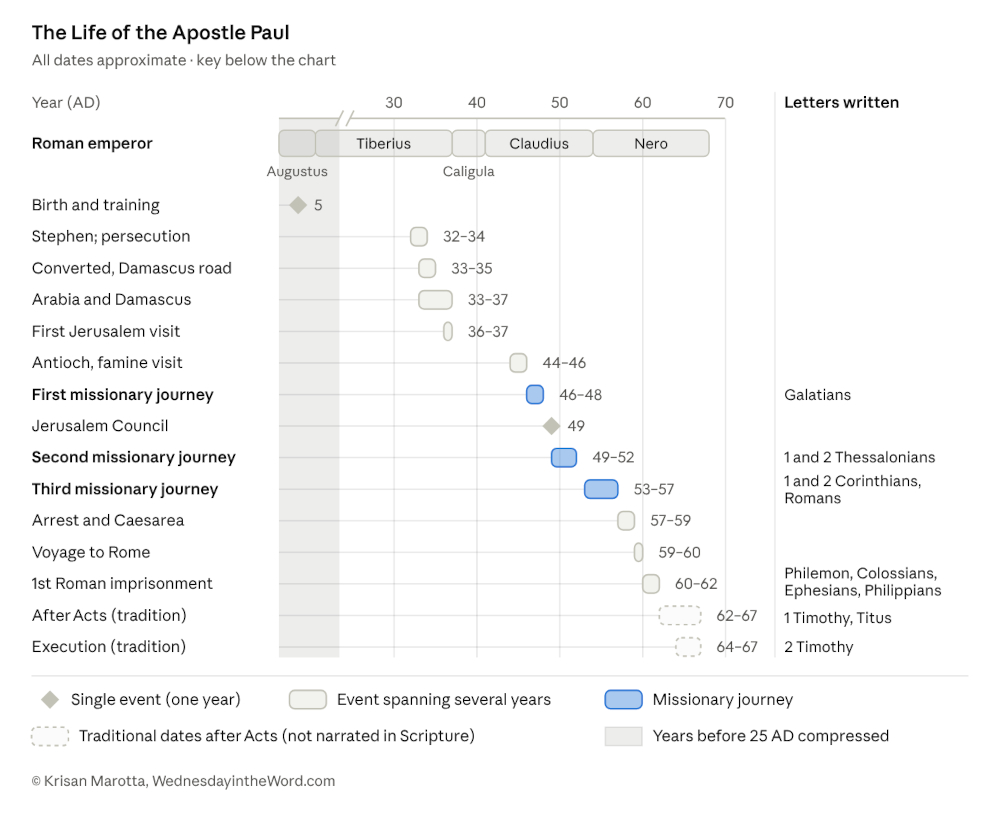
Years below are approximate. The sequence is more secure than the years. The timeline below runs from his early years through his journeys, imprisonment, and death, and notes when he most likely wrote each letter.
The firmest external anchor is the Delphi inscription: Gallio was proconsul of Achaia in AD 51–52, and Paul stood before him in Corinth (Acts 18:12–17). Most other dates are counted backward and forward from that hearing.
Download a free PDF of Life of Paul Handout
Chronology of Paul's Life
About 5 AD Birth & Training
- Acts 22:3; Acts 22:28; Phil 3:4-6
- Born in Tarsus, a free Roman citizen, of the tribe of Benjamin (Acts 22:3, 28; Philippians 3:5).
- Educated in Jerusalem under Gamaliel; a Pharisee (Acts 22:3; 23:6; Philippians 3:5).
- Roman Emperor: Augustus 27 BC- 14 AD
About 32-34 AD - Stephen
- Present at the stoning of Stephen and consenting to it (Acts 7:58; 8:1).
- A persecutor of the church in Jerusalem and beyond (Acts 8:1–3; 9:1–2; 22:4–5; Galatians 1:13).
- Assumes the crucifixion is 30-33 AD
About 33-35 AD - Conversion
- Confronted by Jesus on the road to Damascus (Acts 9:1–19; 22:6–16; 26:12–18).
- Emperor: Tiberius (14–37 AD).
About 33–37 — Arabia and Damascus
- Goes to Arabia and remains.
- Returns to Damascus, and preaches Jesus there (Galatians 1:15–17; Acts 9:19–25).
- Escapes Damascus in a basket while the city is under the ethnarch of Aretas (Acts 9:23–25; 2 Corinthians 11:32–33).
- “After three years” he goes up to Jerusalem (Galatians 1:18). Ancient counting often includes part-years, so the gap may be a little over two years.
About 36–37 — First Jerusalem visit
- Barnabas introduces him to the apostles. He stays with Peter fifteen days and also sees James (Acts 9:26–30; Galatians 1:18–19).
- Opposition sends him to Caesarea and on to Tarsus (Acts 9:30; Galatians 1:21).
- The “silent years” in Syria and Cilicia follow (Galatians 1:21–24).
- Roman Emperor: Caligula (37-41 AD)
About 44–46 — Antioch, then the famine visit
- Barnabas brings him from Tarsus to Antioch, where they teach for a year (Acts 11:25–26).
- Agabus predicts a famine. Barnabas and Saul carry relief to Judea (Acts 11:27–30; 12:25).
- Famine in Rome
- Herod Agrippa I dies in 44 (Acts 12:20–23), and Josephus places a Judean famine under Claudius in the mid-40s.
- Emperor: Claudius (41–54).
- Whether this visit is the one in Galatians 2:1–10 is disputed.
About 46–48 — First journey
- From Antioch, with Barnabas and, at first, John Mark: Cyprus, then Pisidian Antioch, Iconium, Lystra, and Derbe, and back to Antioch (Acts 13–14).
- Mark leaves at Perga (Acts 13:13).
- Writes Galatians about 48–49
About 49 — Jerusalem council
- Dispute over circumcision of Gentile believers. Paul and Barnabas go to Jerusalem. The council decides Gentiles need not become Jews to belong to the church (Acts 15:1–35).
- Claudius expels Jews from Rome about 49 (Suetonius; cf. Acts 18:2). Aquila and Priscilla are among those who leave.
- First Journey (Map)
About 49–52 — Second journey
- Paul and Barnabas split over Mark. Paul takes Silas; Timothy joins at Lystra (Acts 15:36–16:5).
- Macedonia and Achaia: Philippi, Thessalonica, Berea, Athens, Corinth (Acts 16–18).
- About eighteen months in Corinth (Acts 18:11).
- Hearing before Gallio, 51–52, is the fixed point of the chronology (Acts 18:12–17).
- Letters: 1 Thessalonians and 2 Thessalonians, from Corinth, about 50–51.
- Returns to Antioch via Ephesus and Caesarea (Acts 18:18–22).
- Second Journey (Map)
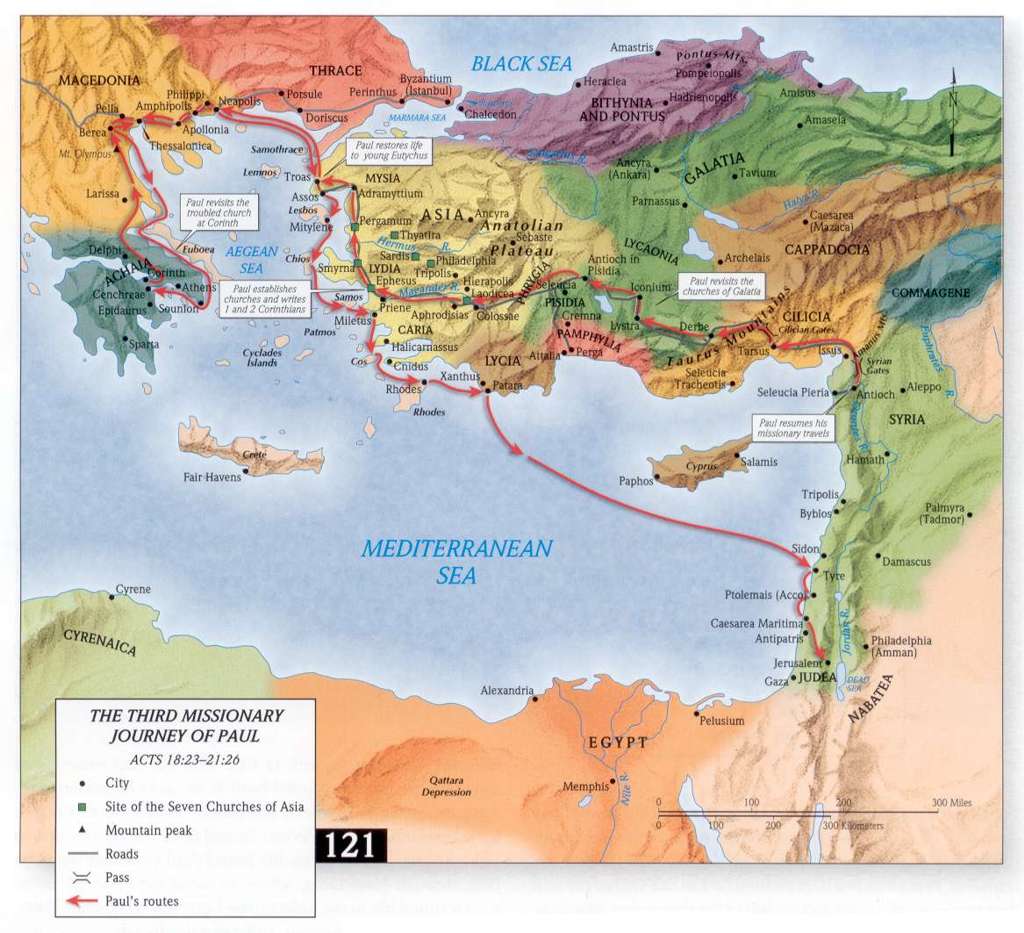
About 53–57 — Third journey
- Through Galatia and Phrygia to Ephesus, where he stays more than two years (Acts 18:23–19:10; 20:31).
- Then Macedonia and three months in Greece, and back toward Jerusalem with the collection (Acts 20:1–21:16; Romans 15:25–28).
- Letters: 1 Corinthians from Ephesus, about 55; 2 Corinthians from Macedonia, about 56; Romans from Corinth, about 57.
- Emperor: Nero (54–68).
- Third Journey (Map)
About 57–59 — Arrest and Caesarea
- Arrested in the temple in Jerusalem (Acts 21:27–36).
- Hearings before the Sanhedrin, Felix, Festus, and Agrippa II. Appeals to Caesar (Acts 22–26).
- Two years in custody in Caesarea (Acts 24:27).
About 59–60 — Voyage to Rome
- Sails for Italy, is shipwrecked on Malta, and winters there (Acts 27:1–28:10).
- Arrives in Rome (Acts 28:11–16).
- Journey to Rome (Map)
About 60–62 — First Roman imprisonment
- House arrest for two years, still preaching (Acts 28:16, 30–31).
- Letters usually placed here: Philemon, Colossians, Ephesians, and Philippians. Philippians may be the latest of the four.
- Acts ends here. It does not say he was released or executed.
About 62–67 — After Acts (traditional, not narrated)
- Early tradition says Paul was released, traveled again, was arrested a second time, and was beheaded in Rome under Nero.
- The Pastoral Epistles were written: 1 Timothy and Titus during the interval, 2 Timothy from the last imprisonment.
- The Fire at Rome is 64 AD.
- Nero’s persecution of Christians follows Tacitus. Persecution under Nero
- Paul is dead by Nero’s own death in 68. A common traditional date for the execution is 64–67.
Paul's Authority
- Paul's authority rests on his divine calling from Jesus Christ.
- Paul received divine revelation from Jesus (Gal 1:12).
- Paul received traditional training in and knowledge of the Scriptures (1 Cor 15:3-5).
In his own letters, Paul’s authority rests on a call from the risen Christ, not on a commission from Jerusalem (Galatians 1:1, 11–12; 1 Corinthians 15:8–10). He also received and passed on the earliest tradition about the death, burial, and resurrection of Jesus (1 Corinthians 15:3–5).
Paul's Sufferings
Soon after his conversion, the Lord told Paul he would suffer for the sake of the gospel (Acts 9:15–16).
- Paul's own record of his sufferings: 1 Cor 15:30–32; 2 Cor 4:7–18; 2 Cor 6:3–10; 2 Cor 11:23–28; 2 Cor 12:5–10; Gal 5:11; Gal 6:7; 2 Tim 3:10–11
- Jewish Opposition: Acts 9:23; 9:29; 13:50; 14:5; 14:19; 17:5; 17:13; 18:12; 21:31; 23:12–13; 25:3
- Gentile Opposition: Acts 14:1; 18:9; 19:23; 16:9; 18:13; 19:23
Paul as Apostle
How do we know Paul was an apostle apart from his own words? Five witnesses vouched for him:
- Peter - 2 Peter 3:15-16
- God (as Luke tells us) - Acts 9:11-16
- Barnabas - Acts 9:26-27
- The Church at Antioch - Acts 13:1
- The Church at Jerusalem - Acts 15:22
Paul's Visits to Jerusalem
- After leaving Damascus; stayed with Peter 15 days (Acts 9:26–30; Gal 1:18–20)
- To bring famine relief (Acts 11:27–30; Gal 2:1–10)
- To attend the Jerusalem Council (Acts 15:1–29; Gal 2:1–10)
- At the end of his second journey (Acts 18:22)
- His final visit, which ended in arrest and prison in Caesarea (Acts 12:15 to Acts 23:35)
Paul's Recorded Sermons
- Acts 13:16–41 - First recorded sermon; Antioch in Pisidia
- Acts 17:22–34 - Sermon at Mars Hill; Athens, Greece
- Acts 20:13–28 - Address to the Ephesian elders; Miletus
- Acts 21:37–22:29 - Stairway address; Jerusalem
- Acts 24:1–23 - Defense before Felix; Caesarea
- Acts 24:24–27 - Address before Felix and Drusilla; Caesarea
- Acts 26:1–28 -Address before Felix, King Agrippa and Bernice; Caesarea
Dates Paul Wrote His Letters
- Galatians AD 48–55 Date and destination debated; early dating places it around the first journey
- 1 Thessalonians AD 50–51 Second journey, probably Corinth
- 2 Thessalonians AD 51–52 Second journey, probably Corinth
- 1 Corinthians AD 54–55 Third journey, Ephesus
- 2 Corinthians AD 55–56 Third journey, Macedonia
- Romans AD 56–57 Third journey, Corinth
- Ephesians AD 60–62 during Roman imprisonment
- Philippians AD 60–62 during Roman imprisonment
- Colossians AD 60–62 during Roman imprisonment
- Philemon AD 60–62 during Roman imprisonment
- 1 Timothy AD 63–65 after release from Roman imprisonment
- Titus AD 63–65 after release from Roman imprisonment
- 2 Timothy AD 64–67 during Paul's final imprisonment
These are traditional approximate dates and assumes Pauline authorship of all thirteen letters. The dating and authorship of some letters are disputed in some circles.
Further Study:
Who was Paul?
Paul’s Missionary Journeys
Page Views: 7,118