Blog

Latest Blog Posts from Wednesday in the Word, the podcast about what the Bible means and how we know.

October 2020 Reflections

October 2020 Reflections

October was a big month for WitW! I finished a resource page for every book of the Bible; I finished the “quotations” pages, compiling all the places where Scripture quotes Scripture. We reached the culmination of the podcast series on the Holy Spirit (#8). And I need a bit less than 8,000 downloads to reach my goal of breaking 150,000.

read more...
James’ Use of the Old Testament

James’ Use of the Old Testament

The New Testament is our divinely inspired commentary on the Old Testament. When studying a passage, it’s often helpful to see how other biblical authors understood it. Here is James’ use of the Old Testament in his letter.

read more...
08 Who is the Holy Spirit?

08 Who is the Holy Spirit?

As a new believer, I thought the Holy Spirit was like the “force” in Star Wars: something I had to access to find success. Paul has a different view in this passage. The Holy Spirit is the active love of God intervening to make us people who will persevere in faith.

read more...
Mark’s Use of the Old Testament

Mark’s Use of the Old Testament

The New Testament is our divinely inspired commentary on the Old Testament. When studying a passage, it’s often helpful to see how other biblical authors understood it. Here is Mark’s use of the Old Testament in his gospel.

read more...
Matthew’s Use of the Old Testament

Matthew’s Use of the Old Testament

The New Testament is our divinely inspired commentary on the Old Testament. When studying a passage, it’s often helpful to see how other biblical authors understood it. Here are Matthew’s quotations and allusions to the Old Testament in his gospel.

read more...
Introduction to Ancient Egypt

Introduction to Ancient Egypt

The first third of the book of Exodus takes place in Egypt. The Israelites had lived in Egypt for 400 years and were steeped in Egyptian culture. The cultural and historical setting of Exodus is ancient Egypt. Here’s a brief introduction.

read more...
Introduction to the Intertestamental Period

Introduction to the Intertestamental Period

The time between the end of the Old Testament (400BC from the prophet Malachi) to the preaching of John the Baptist (25 AD) is known as the “intertestamental” period. Here’s an overview of what happened.

read more...
07 What is Being Sealed with the Holy Spirit?

07 What is Being Sealed with the Holy Spirit?

Paul describes believers as sealed with the Holy Spirit. A seal fulfills a past promise and pledges a future inheritance. A King’s seal had a three-fold purpose: 1) to guarantee authenticity, 2) to name the rightful owner, and 3) to protect from being tampered with or harmed.

read more...
Who were the Pharisees?

Who were the Pharisees?

Who were the Pharisees? A short guide to the most influential religious party of Jesus’ day, what they actually believed, and why Jesus argued with them.

read more...
When did the Exodus happen?

When did the Exodus happen?

When it comes to biblical history, you can divide scholars into minimalists and maximalists. Minimalists believe almost nothing in the Old Testament is historically accurate. Maximalists believe the Old Testament is a reasonably accurate historical document. Among the maximalists, there are two main competing theories about the date of the Exodus: early and late.

read more...
Northern Kingdom at a Glance | WednesdayintheWord.com

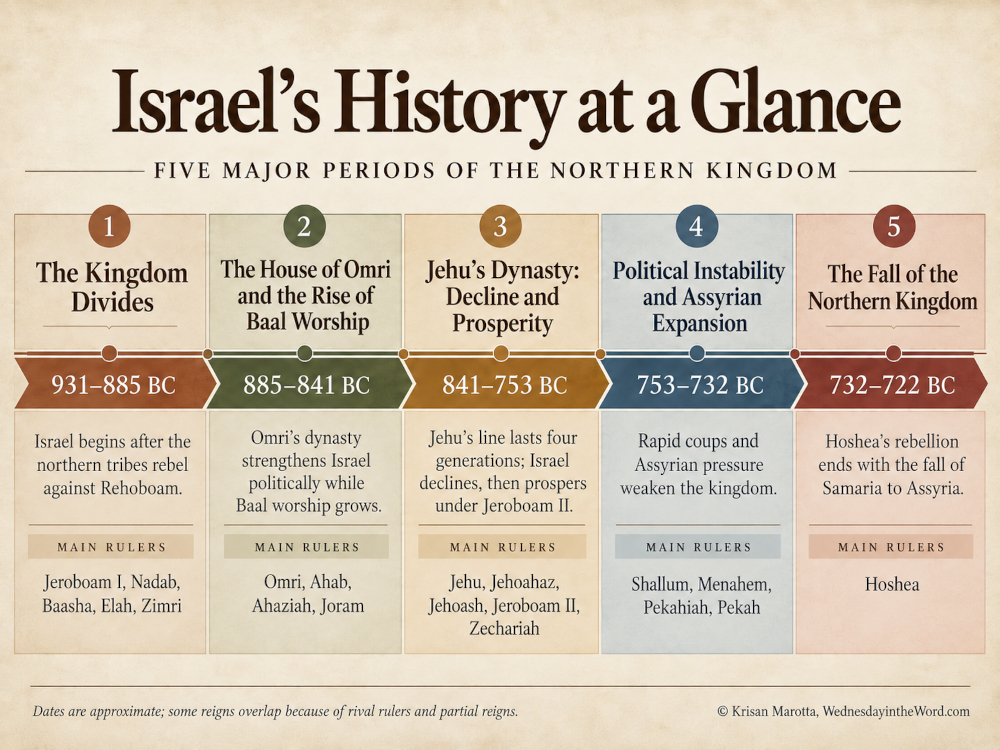
Introduction to the Northern Kingdom

After the death of King Solomon, two of his sons, Rehoboam and Jeroboam, fought for the throne. When Rehoboam harshly raised taxes on the people, the 10 northern tribes rebelled and installed Jeroboam as their king, creating the northern kingdom of Israel. The two southern tribes, Benjamin and Judah, remained with Rehoboam and became the kingdom of Judah.

read more...
06 Does the Holy Spirit Give a New Heart?

06 Does the Holy Spirit Give a New Heart?

Both the Old and New Testaments speak about the need for God to spiritually renew us and change our hearts. Both associate this spiritual renewal with the Spirit of God. But there is only one really clear Old Testament passage on this topic.

read more...
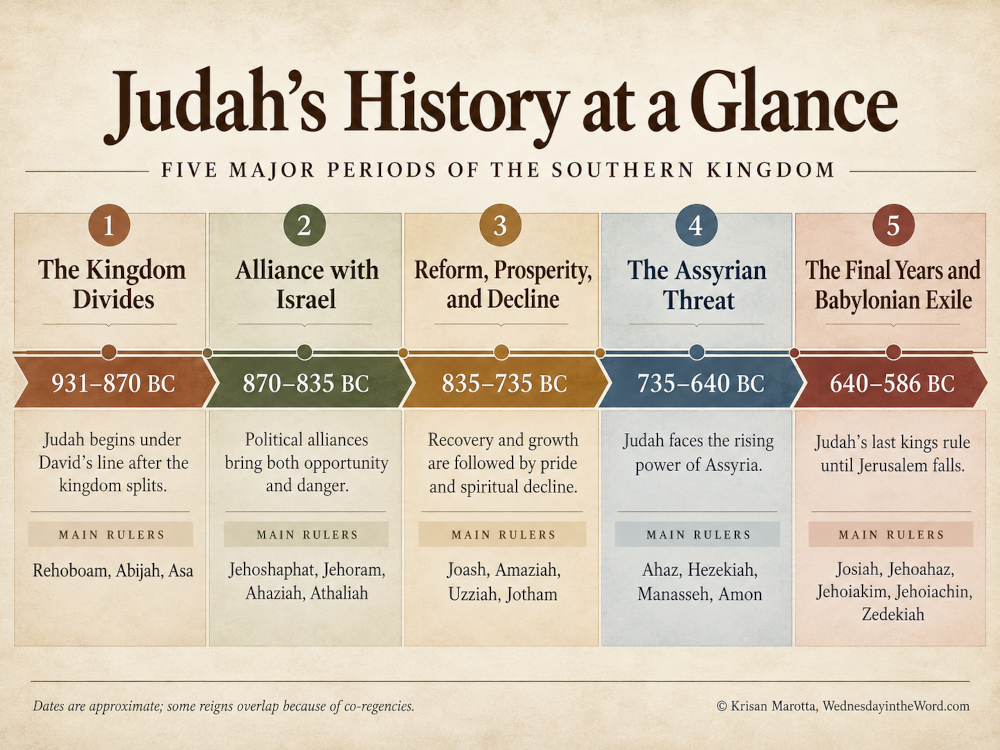
Introduction to the Southern Kingdom

Introduction to the Southern Kingdom

After the death of King Solomon, two of his sons, Rehoboam and Jeroboam, fought for the throne. When Rehoboam harshly raised taxes on the people, the 10 northern tribes rebelled and installed Jeroboam as their king, creating the northern kingdom of Israel. The two southern tribes, Benjamin and Judah, remained with Rehoboam and became the kingdom of Judah.

read more...
05 Did the Prophets Have the Holy Spirit?

05 Did the Prophets Have the Holy Spirit?

Most of the Old Testament references to the Holy Spirit involve his work empowering the leaders of Israel to protect the nation. But a second way we see the Spirit of God working in the Old Testament is giving revelation to the prophets.

read more...
September News from WednesdayintheWord.com

September 2020 Reflections

WitW: Do you know who the Holy Spirit is? The 2020 State of Theology survey shows fewer evangelicals understand the Holy Spirit’s work in salvation. Let’s study the Holy Spirit together.

read more...
What is Theology?

What is Theology?

“One is sometimes (not often) glad not to be a great theologian; one might so easily mistake it for being a good Christian.” – C.S. Lewis

read more...
02 How does the Holy Spirit Work? Universal vs Individual

02 How does the Holy Spirit Work? Universal vs Individual

1Corinthians 12 teaches an important distinction between the type of work the Holy Spirit does. The “universal” work of the Holy Spirit is a work that he does for all believers to bring about the inner transformation of faith. The “individual” works of the Holy Spirit are works he does in some believers but not others.

read more...