
Updated October 2026
After King Solomon died, his son Rehoboam inherited the throne. When Rehoboam refused to lighten the heavy burdens Solomon had placed on the people, ten northern tribes rebelled and made Jeroboam, a former official under Solomon, their king. The northern tribes became the kingdom of Israel, while Judah and Benjamin remained loyal to Rehoboam, forming the Southern Kingdom of Judah (1 Kings 12:1–24).
For the next 345 years, Judah was ruled by descendants of David, with one notable interruption. Some kings followed the Lord and sought to restore true worship. Others led the people into idolatry. All faced the challenge of remaining faithful to God while powerful neighboring kingdoms threatened their independence.
The story of Judah is recorded primarily in 1–2 Kings and 2 Chronicles. It is also the historical setting for many of the Old Testament prophets, including Isaiah, Micah, Jeremiah, Habakkuk, and Zephaniah.
This overview follows the kings of Judah chronologically, highlighting the political events, spiritual condition, and biblical passages associated with each reign.
The Southern Kingdom at a Glance
- Name: Judah, also called the Southern Kingdom
- Dates: Approximately 931–586 BC
- Capital: Jerusalem
- Tribes: Primarily Judah and Benjamin, with Levites and others who remained faithful to Jerusalem worship
- Royal dynasty: Descendants of King David, interrupted by Athaliah
- Number of rulers: 19 kings and Queen Athaliah
- Primary Scripture:1 Kings 12–2 Kings 25; 2 Chronicles 10–36
- Major enemies: Israel, Egypt, Aram, Assyria, Babylon
- End of kingdom: Jerusalem destroyed by Babylon in 586 BC
Key Dates in Judah's History
- 931 BC The united kingdom divides into Israel and Judah.
- c. 925 BC Shishak (Sheshonq I) of Egypt invades Judah.
- 841 BC Queen Athaliah seizes the throne.
- 835 BC Joash becomes king and the Davidic dynasty is restored.
- 722 BC Assyria conquers the Northern Kingdom of Israel.
- 701 BC Sennacherib of Assyria invades Judah during Hezekiah's reign.
- 640 BC Josiah becomes king at eight years old.
- 622 BC The Book of the Law is discovered during repairs to the temple, prompting major reforms.
- 605 BC Babylon defeats Egypt at Carchemish and becomes the dominant power in the region.
- 597 BC Babylon captures Jerusalem and deports King Jehoiachin and many others.
- 586 BC Babylon destroys Jerusalem and Solomon's temple.
A note about dates: Ancient chronologies sometimes differ by a few years, particularly when kings ruled jointly with their fathers. The dates in this overview are approximate.
Download a free 6-page PDF handout of this information
Feel free to share the unmodified files with your group or church. Please credit the source and link back to WednesdayintheWord.com.
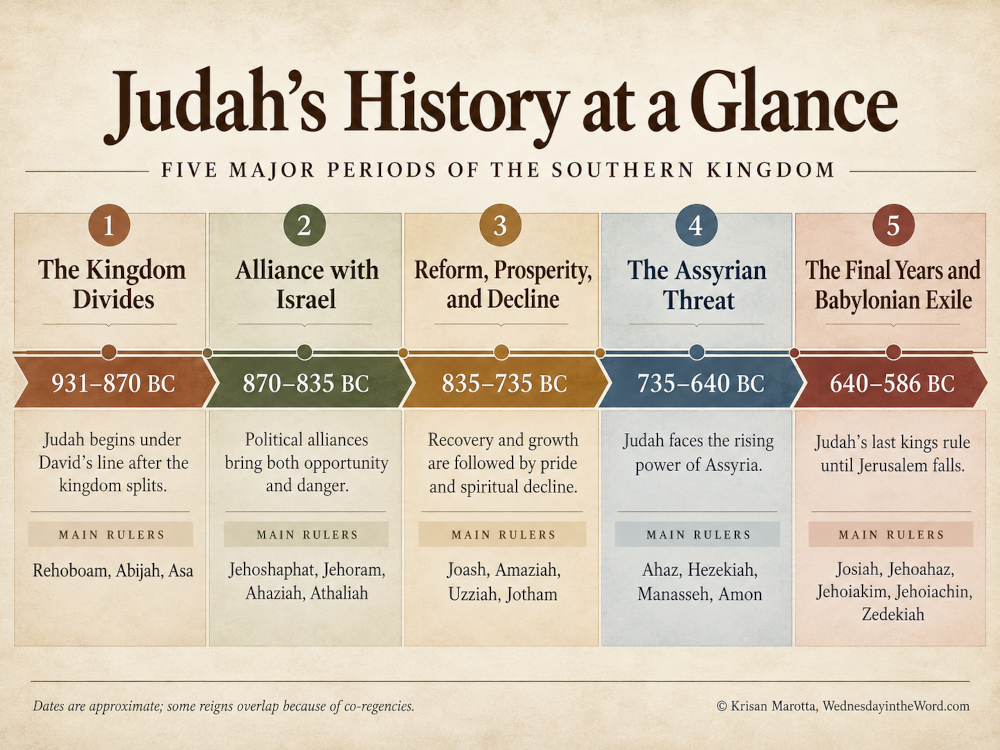
1. The Kingdom Divides (931–870 BC)
Kings: Rehoboam, Abijah, Asa
The Southern Kingdom began with a crisis.
When Solomon died, his son Rehoboam inherited the throne. The northern tribes asked him to reduce the heavy burdens Solomon had placed on them. Instead, Rehoboam threatened to increase those burdens.
The northern tribes rebelled and made Jeroboam, a former official under Solomon, their king (1 Kings 12). Rehoboam retained control of Judah and Benjamin, while the other tribes formed the Northern Kingdom of Israel.
What had been one nation under David and Solomon became two rival kingdoms.
For the next several decades, Israel and Judah fought frequent wars. Judah also faced threats from Egypt and other neighboring nations. During this period, the central question was whether David's descendants would continue trusting the Lord or seek security through military strength and foreign alliances.
Rehoboam (931–913 BC)
Scripture: 1 Kings 12; 14:21–31; 2 Chronicles 10–12
- Rehoboam was Solomon's son and the first king of the Southern Kingdom.
- His harsh response to the northern tribes' grievances resulted in the division of the kingdom.
- He fortified cities throughout Judah to strengthen its defenses.
- He and the people abandoned the law of the Lord after his kingdom became established (2 Chronicles 12:1).
- Shishak, king of Egypt, invaded Judah and took treasures from the temple and royal palace.
- When confronted with judgment, Rehoboam humbled himself, and the Lord limited the destruction (2 Chronicles 12:6–12).
Key point: Rehoboam inherited a united kingdom but lost most of it. His reign illustrates how unwise leadership and disobedience can have lasting consequences.
Abijah (Abijam) (913–911 BC)
Scripture: 1 Kings 15:1–8; 2 Chronicles 13
- Abijah continued the conflict with Jeroboam, king of Israel.
- Before one battle, he declared that Judah had preserved the worship of the Lord while Israel had abandoned it.
- Judah defeated Israel in the battle recorded in 2 Chronicles 13.
- Despite this victory, 1 Kings 15:3 says Abijah's heart was not wholly true to the Lord.
Key point: Abijah defended Judah's claim to legitimate worship, but his personal faithfulness did not match his public profession.
Asa (911–870 BC)
Scripture: 1 Kings 15:9–24; 2 Chronicles 14–16
- Asa instituted reforms, removing foreign altars and calling Judah to seek the Lord.
- He relied upon God when confronted by a large invading army led by Zerah the Cushite (2 Chronicles 14).
- He renewed Judah's covenant commitment to the Lord (2 Chronicles 15).
- Later, when threatened by Baasha of Israel, he paid Ben-hadad of Aram to attack Israel rather than relying upon the Lord (2 Chronicles 16).
- The prophet Hanani rebuked him for depending upon foreign help.
Key point: Asa's reign demonstrates the difference between relying on the Lord and relying on human strength. His early faithfulness did not prevent him from making serious mistakes later.
2. Alliance with Israel (870–835 BC)
Rulers: Jehoshaphat, Jehoram, Ahaziah, Athaliah
The relationship between Israel and Judah changed dramatically during this period.
Instead of fighting continually, the two kingdoms formed political and military alliances. Jehoshaphat of Judah allied himself with Ahab of Israel, and a marriage connected the two royal families.
Politically, the alliance offered advantages. Spiritually, it introduced dangerous influences into Judah's royal household.
Through Athaliah, a member of Ahab's family, the worship of Baal gained a foothold in Judah. The period ended with a violent struggle for the throne that nearly destroyed David's royal line.
Jehoshaphat (870–848 BC)
Scripture: 1 Kings 22:41–50; 2 Chronicles 17–20
- Jehoshaphat sought to follow the Lord and strengthened Judah's defenses.
- He sent officials, Levites, and priests throughout Judah to teach the Book of the Law (2 Chronicles 17:7–9).
- He established judges and instructed them to administer justice in the fear of the Lord.
- He formed an alliance with Ahab and joined him in battle against Aram, despite prophetic warnings.
- His alliance with Ahab's family eventually had serious consequences for Judah.
- When a coalition of enemies threatened Jerusalem, Jehoshaphat prayed and depended upon the Lord for deliverance (2 Chronicles 20).
Key point: Jehoshaphat was a faithful reformer whose political alliances nevertheless brought long-term trouble to Judah.
Jehoram (848–841 BC)
Scripture: 2 Kings 8:16–24; 2 Chronicles 21
- Jehoram married Athaliah, a member of Ahab's royal family.
- After securing the throne, he killed his brothers and some of Judah's officials.
- He promoted idolatry and led Judah away from the Lord.
- Edom and Libnah rebelled against Judah during his reign.
- Elijah sent Jehoram a written warning announcing God's judgment against him.
- Philistine and Arabian raiders invaded Judah and carried away members of his household.
- Jehoram died after a severe illness.
Key point: Through Jehoram, the idolatry of Ahab's house spread into the Southern Kingdom.
Ahaziah (841 BC)
Scripture: 2 Kings 8:25–29; 9:27–29; 2 Chronicles 22:1–9
- Ahaziah ruled Judah for approximately one year.
- His mother Athaliah encouraged him to follow the ways of Ahab's family.
- He joined Joram, king of Israel, in a campaign against Hazael of Aram.
- While visiting the wounded Joram, Ahaziah was caught in Jehu's revolt against Ahab's dynasty.
- Jehu killed both kings.
Key point: Ahaziah's allegiance to Ahab's family led to his downfall.
Queen Athaliah (841–835 BC)
Scripture: 2 Kings 11; 2 Chronicles 22:10–23:21
- Following Ahaziah's death, Athaliah seized control of Judah.
- She attempted to destroy the remaining royal heirs.
- Ahaziah's infant son Joash was rescued by his aunt Jehosheba and hidden in the temple.
- For six years, Athaliah ruled while Joash remained concealed.
- In the seventh year, Jehoiada the priest organized a successful effort to restore Joash to the throne.
- Athaliah was executed, and the worship of Baal was removed from the temple.
Key point: Athaliah's attempt to eliminate David's descendants failed. The royal line continued through Joash, preserving the dynasty God had promised David (2 Samuel 7:12–16).
3. Reform, Prosperity, and Decline (835–735 BC)
Kings: Joash, Amaziah, Uzziah, Jotham
After Athaliah's overthrow, Judah experienced a period of recovery and relative prosperity.
Several kings repaired the damage caused by earlier rulers, strengthened the nation's defenses, and expanded its territory. Yet their success brought another danger: pride and self-reliance.
These kings often began their reigns well, only to stumble later. Their stories show that political prosperity does not necessarily produce lasting faithfulness.
Joash (835–796 BC)
Scripture: 2 Kings 12; 2 Chronicles 24
- Joash became king at seven years old under the guidance of Jehoiada the priest.
- He repaired the temple and restored proper worship.
- As long as Jehoiada lived, Joash followed the Lord.
- After Jehoiada's death, Joash listened to officials who encouraged idolatry.
- He rejected the warning of Zechariah, Jehoiada's son, and ordered him killed.
- When Hazael of Aram threatened Jerusalem, Joash surrendered treasures from the temple and royal palace.
- His own servants eventually assassinated him.
Key point: Joash's faithfulness depended too heavily on Jehoiada's influence. After his mentor died, he abandoned the reforms he had once supported.
Amaziah (796–767 BC)
Scripture: 2 Kings 14:1–20; 2 Chronicles 25
- Amaziah initially did what was right in the Lord's eyes, although not wholeheartedly.
- He punished those responsible for his father's assassination while sparing their children, in keeping with the Law of Moses.
- He defeated Edom but then adopted the gods of the very people he had conquered.
- Confident after his victory, he challenged Jehoash, king of Israel, to battle.
- Israel defeated Judah, broke down part of Jerusalem's wall, and took treasures and hostages.
- Amaziah was eventually killed in a conspiracy.
Key point: Amaziah's early obedience gave way to pride, idolatry, and an unnecessary war.
Uzziah (Azariah) (c. 792–740 BC, including co-regency)
Scripture: 2 Kings 15:1–7; 2 Chronicles 26
- Uzziah became king at sixteen and ruled for a total of 52 years.
- He strengthened Judah's army, fortified Jerusalem, and expanded the kingdom's influence.
- His military and agricultural projects contributed to a period of prosperity.
- The biblical writer says he was marvelously helped until he was strong (2 Chronicles 26:15).
- His success led to pride. He entered the temple to burn incense, a duty reserved for the priests.
- The Lord afflicted him with a serious skin disease, and he lived separately for the remainder of his life.
- His son Jotham governed during his final years.
Key point: Uzziah's downfall came not through military defeat, but through pride after years of success.
Jotham (c. 750–735 BC, including co-regency)
Scripture: 2 Kings 15:32–38; 2 Chronicles 27
- Jotham governed during Uzziah's illness and later ruled in his own right.
- He continued building projects and strengthened Judah's defenses.
- He defeated the Ammonites and received tribute from them.
- He followed the Lord, although the people continued acting corruptly.
- Second Chronicles 27:6 connects his strength with his steadfast obedience to God.
Key point: Jotham demonstrated personal faithfulness, but the spiritual condition of the nation remained troubled.
4. The Assyrian Threat (735–640 BC)
Kings: Ahaz, Hezekiah, Manasseh, Amon
During the eighth century BC, Assyria became the dominant power in the ancient Near East.
Smaller kingdoms faced a difficult choice: submit to Assyria, attempt to form alliances against it, or resist and risk invasion.
The Northern Kingdom of Israel fell to Assyria in 722 BC. Judah survived, but it faced continuing military threats and demands for tribute.
This period provides one of the clearest contrasts between two kings: Ahaz, who sought security through Assyria, and his son Hezekiah, who trusted the Lord.
Ahaz (c. 735–715 BC)
Scripture: 2 Kings 16; 2 Chronicles 28; Isaiah 7
- Ahaz promoted idolatry and introduced pagan religious practices into Judah.
- When Israel and Aram threatened Jerusalem, Ahaz sought help from Tiglath-pileser III of Assyria.
- He paid Assyria with silver and gold taken from the temple and royal treasury.
- Isaiah confronted Ahaz and called him to trust the Lord rather than depend upon foreign powers (Isaiah 7).
- Ahaz copied an altar he saw in Damascus and introduced it into the temple worship system.
- Judah became increasingly dependent upon Assyria.
Key point: Ahaz sought protection from a powerful empire rather than trusting the God who had promised to preserve David's dynasty.
Hezekiah (715–686 BC)
Scripture: 2 Kings 18–20; 2 Chronicles 29–32; Isaiah 36–39
- Hezekiah reversed many of Ahaz's religious policies.
- He reopened and repaired the temple, restored the priesthood, and celebrated Passover.
- He removed idolatrous worship sites and destroyed the bronze serpent that had become an object of worship.
- In 701 BC, Sennacherib of Assyria invaded Judah and threatened Jerusalem.
- Hezekiah brought the crisis before the Lord in prayer, and Isaiah announced God's promise of deliverance.
- Jerusalem survived the Assyrian threat (2 Kings 19).
- Hezekiah also strengthened Jerusalem's water supply, including the famous tunnel that brought water from the Gihon Spring.
Key point: Unlike Ahaz, Hezekiah responded to the threat of Assyria by calling the nation to trust the Lord.
Manasseh (c. 697–642 BC, including co-regency)
Scripture: 2 Kings 21:1–18; 2 Chronicles 33:1–20
- Manasseh ruled for 55 years, the longest reign of any king of Judah.
- He reversed Hezekiah's reforms and promoted widespread idolatry.
- He introduced pagan altars into the temple and practiced divination and other forbidden forms of worship.
- Second Kings also condemns him for shedding much innocent blood.
- According to 2 Chronicles 33, Manasseh was taken captive by Assyrian commanders, humbled himself, and prayed to the Lord.
- After being restored to Jerusalem, he removed foreign gods and attempted religious reforms.
Key point: Manasseh's reign shows both the seriousness of Judah's rebellion and the possibility of repentance, even after great wickedness.
Amon (642–640 BC)
Scripture: 2 Kings 21:19–26; 2 Chronicles 33:21–25
- Amon followed the idolatrous practices of his father Manasseh.
- Unlike Manasseh, he did not humble himself before the Lord.
- He was assassinated by his own servants after ruling only two years.
- The people of Judah killed the conspirators and placed his young son Josiah on the throne.
Key point: Amon continued the spiritual decline that had marked much of Manasseh's reign, setting the stage for Josiah's reforms.
5. The Final Years and Babylonian Exile (640–586 BC)
Kings: Josiah, Jehoahaz, Jehoiakim, Jehoiachin, Zedekiah
Judah's final decades began with one of its most significant periods of spiritual reform.
When Josiah became king, the nation had endured decades of idolatry. His efforts to restore covenant faithfulness brought dramatic changes. But those reforms did not permanently reverse Judah's spiritual decline.
Meanwhile, the political landscape was changing.
Assyria weakened and eventually collapsed. Egypt attempted to regain influence in the region. Babylon emerged as the new dominant power.
The last four kings of Judah ruled under increasing foreign pressure. Each faced the consequences of Judah's political weakness and continued disobedience.
Josiah (640–609 BC)
Scripture: 2 Kings 22–23:30; 2 Chronicles 34–35
- Josiah became king when he was eight years old.
- He began removing idolatrous practices and restoring true worship.
- During repairs to the temple, the high priest Hilkiah discovered the Book of the Law.
- When Josiah heard its contents, he recognized how far Judah had departed from God's commandments.
- He consulted Huldah the prophetess, who confirmed that judgment would come upon Judah, though not during Josiah's lifetime.
- Josiah renewed the covenant, removed idols, and celebrated a Passover unlike any observed for generations.
- He was killed at Megiddo while confronting Pharaoh Neco of Egypt.
Key point: Josiah responded to God's Word with humility and obedience. Yet even his extensive reforms could not permanently change the nation's direction.
Jehoahaz (Shallum) (609 BC)
Scripture: 2 Kings 23:31–34; 2 Chronicles 36:1–4
- Jehoahaz became king after Josiah's death.
- He did what was evil in the Lord's sight.
- After only three months, Pharaoh Neco removed him from the throne.
- He was taken captive to Egypt, where he died.
- Neco installed Jehoahaz's brother Eliakim as king and renamed him Jehoiakim.
Key point: Judah's kings were increasingly subject to the decisions of foreign rulers.
Jehoiakim (Eliakim) (609–598 BC)
Scripture: 2 Kings 23:34–24:7; 2 Chronicles 36:5–8; Jeremiah 36
- Jehoiakim was installed as king by Pharaoh Neco of Egypt.
- In 605 BC, Nebuchadnezzar defeated Egypt at Carchemish, making Babylon the dominant power in the region.
- Judah became subject to Babylon, but Jehoiakim later rebelled.
- Jeremiah repeatedly warned Judah of the coming judgment.
- When a scroll containing Jeremiah's prophecies was read to Jehoiakim, he cut it apart and burned it (Jeremiah 36).
- Babylonian pressure against Judah increased as Jehoiakim's reign came to an end.
Key point: Jehoiakim illustrates Judah's refusal to listen to God's warnings, even as the threatened judgment approached.
Jehoiachin (Jeconiah) (598–597 BC)
Scripture: 2 Kings 24:8–17; 2 Chronicles 36:9–10
- Jehoiachin succeeded his father Jehoiakim during the Babylonian crisis.
- He ruled for approximately three months.
- In 597 BC, Nebuchadnezzar captured Jerusalem and took Jehoiachin prisoner.
- Many leading citizens, soldiers, craftsmen, and officials were deported to Babylon.
- The prophet Ezekiel was among those taken into exile.
- Nebuchadnezzar installed Jehoiachin's uncle Mattaniah as king, changing his name to Zedekiah.
- Years later, Jehoiachin was released from prison and given a place at the Babylonian king's table (2 Kings 25:27–30).
Key point: Jehoiachin's exile marked the effective end of Judah's independent monarchy. Yet the final verses of Kings preserve a small sign of hope for David's royal line.
Zedekiah (597–586 BC)
Scripture: 2 Kings 24:18–25:21; 2 Chronicles 36:11–21; Jeremiah 37–39; 52
- Zedekiah was Judah's final king.
- He ruled as a Babylonian vassal but eventually rebelled against Nebuchadnezzar.
- Jeremiah repeatedly warned him that resistance would bring destruction upon Jerusalem.
- Babylon laid siege to the city, and conditions inside became desperate.
- In 586 BC, Jerusalem fell. The Babylonians burned the temple, destroyed the royal palace, and broke down the city's walls.
- Zedekiah attempted to escape but was captured. His sons were killed before him, and he was blinded and taken to Babylon.
- Many inhabitants were deported, while some of the poorest people remained in the land.
- Gedaliah was appointed governor over those who remained.
Key point: The destruction of Jerusalem fulfilled the warnings God had repeatedly sent through his prophets. Judah's kings had failed to lead the people in covenant faithfulness, and the kingdom came to an end.
Why Did Judah Fall?
The books of Kings and Chronicles do not explain Judah's destruction merely as the result of poor political decisions or military weakness.
The biblical writers repeatedly emphasize the nation's failure to remain faithful to the Lord.
The people worshiped other gods, ignored God's commandments, and refused to listen to the prophets sent to warn them.
Second Chronicles 36:15–16 explains that the Lord repeatedly sent messengers because he had compassion on his people and his dwelling place. But the people continued rejecting his words until judgment came.
Yet the fall of Jerusalem did not mean God had abandoned his promises.
The book of Kings ends with Jehoiachin, a descendant of David, receiving unexpected kindness in Babylon. Chronicles ends with the decree of Cyrus allowing the exiles to return and rebuild the temple.
Judah's monarchy had ended, but God's purposes for his people had not.
Where to Read the History of Judah
The history of the Southern Kingdom is recorded primarily in two places:
1–2 Kings focuses on both Israel and Judah, evaluating their rulers according to their faithfulness to God's covenant.
- 1 Kings 12–15 — The division of the kingdom and Judah's first kings.
- 1 Kings 22:41–50 — Jehoshaphat.
- 2 Kings 8–16 — Jehoram through Ahaz, interspersed with the history of northern kings.
- 2 Kings 18–25 — Hezekiah through Jerusalem's destruction.
2 Chronicles concentrates primarily on the Davidic dynasty in Judah, giving special attention to the temple, priesthood, worship, and religious reforms.
- 2 Chronicles 10–12 — Rehoboam and the division.
- 2 Chronicles 13–20 — Abijah, Asa, and Jehoshaphat.
- 2 Chronicles 21–28 — Jehoram through Ahaz.
- 2 Chronicles 29–36 — Hezekiah through Judah's fall, concluding with Cyrus's decree.
How the Biblical Writers Introduce a King
The books of Kings often follow a recognizable pattern when introducing a new ruler.
They tell us when he began to reign, how long he ruled, and which king was ruling in the other kingdom. For Judah's kings, they frequently record the king's mother. They also give a brief evaluation of whether he did what was right or evil in the Lord's sight.
For example, 1 Kings 15:1–3 introduces Abijah, identifies his mother Maacah, gives the length of his reign, and evaluates his faithfulness.
The accounts often conclude by noting the king's death, burial, and successor.
This pattern makes it easier to follow the overlapping histories of Israel and Judah and helps us recognize the biblical writer's central concern: whether the king was faithful to the Lord.
Related Bible Study Resources
- Kings of Israel and Judah: Complete Chart
- Introduction to the Northern Kingdom
- Overview of Biblical History
- Introduction to the Exile and Return
- 1 & 2 Kings Bible Study Resources
- 1 & 2 Chronicles Bible Study Resources
For further reading, see the introductions to Kings and Chronicles in the ESV Global Study Bible and Alfred Edersheim's Bible History: Old Testament.
Major Attacks on Jerusalem
Throughout its history, the Southern Kingdom faced repeated invasions from neighboring nations and powerful empires. Some attacks devastated the countryside without capturing Jerusalem. Others breached the city's defenses, carried away treasures and captives, or ultimately destroyed the city.
- 925 BC -- By Shishak, king of Egypt; Invaded Judah during Rehoboam's reign and took treasures from Jerusalem's temple and palace (1 Kings 14:25-26; 2 Chronicles 12).
- 845 BC -- By the Philistines and Arabians; Invaded Judah during Jehoram's reign and carried away royal possessions and members of his household (2 Chronicles 21:16–17).
- 790 BC - By Jehoash, king of Israel; Defeated Amaziah, king of Judah, broke down part of Jerusalem's wall, and took treasures and hostages (2 Kings 149-14; 2 Chronicles 25:17-24).
- 701 BC - by Sennacherib, king of Assyria; Invaded Judah and captured fortified cities, including Lachish. Jerusalem was threatened but not conquered (2 Kings 18–19; 2 Chronicles 32; Isaiah 36–37).
- 597 BC - By Nebuchadnezzar, king of Babylon; Captured Jerusalem, removed King Jehoiachin, and deported many leading citizens, including Ezekiel (2 Kings 24:10–17; 2 Chronicles 36:9–10).
- 588-586 BC - By Nebuchadnezzar, king of Babylon; Besieged Jerusalem after Zedekiah's rebellion. The city fell in 586 BC, and the Babylonians destroyed the temple and royal palace (2 Kings 25:1–21; Jeremiah 39; 52)
These were not the only military threats Judah faced, but they were among the major campaigns that shaped its history.
The two Babylonian conquests were particularly significant.
- In 597 BC, Jerusalem surrendered and many inhabitants were deported, but the city and temple remained standing.
- In 586 BC, Babylon returned, destroyed Jerusalem and its temple, and brought the kingdom of Judah to an end.
Resources
- Chart: Kings of Israel & Judah
- Chart: Bible History at a glance
- Introduction to the Exile and Return
- Introduction to the Northern Kingdom
- 1&2 Chronicles
- 1&2 Kings
- Jensen’s Survey of the Old Testament
- Blue Letter Bible: Old Testament Timeline
Alfred Edersheim Old Testament Bible History:
- Book 5 — Birth Of Solomon To Reign Of Ahab
- Book 6 — The Reign Of Ahab To The Decline Of The Two Kingdoms
- Book 7 — From The Decline Of The Two Kingdoms To The Assyrian And Babylonian Captivity
Maps
- The New Babylonian Empire and Ezekiel – BibleHistory.com
- The New Babylonian Empire and Egypt – BibleHistory.com
- The Babylonian Captivity – BibleHistory.com
- The Divided Kingdom – Biblehub.com
- The Kingdom of Judah – Biblehub.com
- The Captivity of Judah – Biblehub.com
- The Restoration – Biblehub.com
- Deportations and Returns under Assyria and Babylon -Idubiblia.org
- Assyrian and Babylonian and Greek Empires -Idubiblia.org
Series: Bible Study 101
Page Views: 1,045